Intelligence-Driven Hunting: A Complete Framework
A full framework for running threat hunts entirely driven by structured cyber threat intelligence, with minimal untested assumptions.
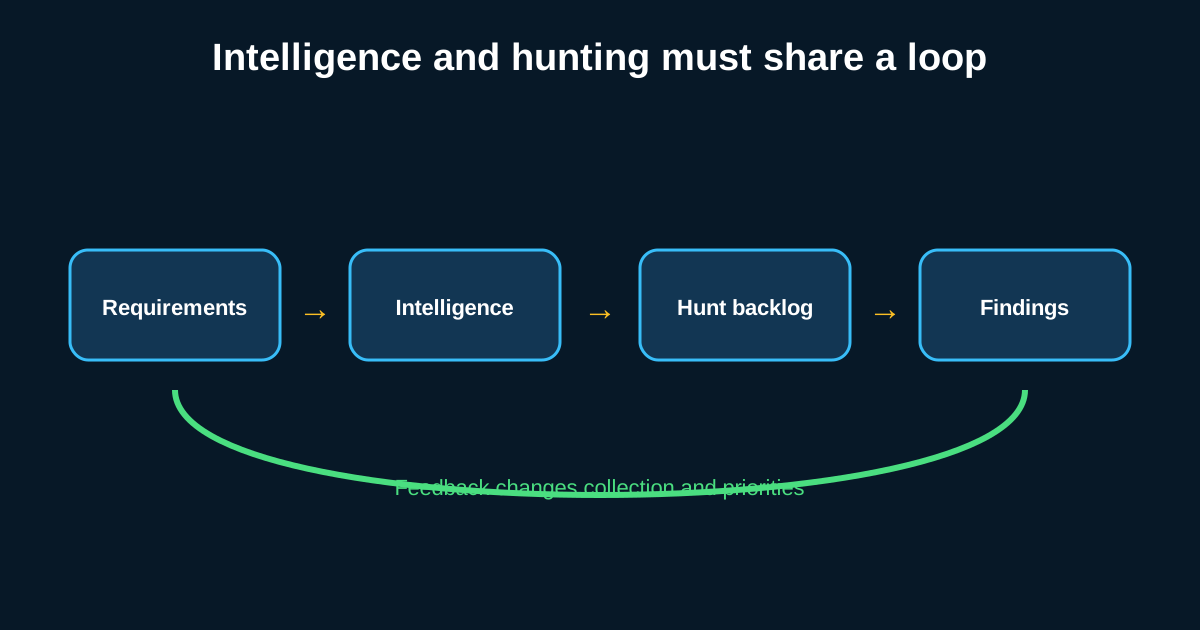
There’s a meaningful difference between “reading some threat intel and getting a hunt idea from it” and running a fully intelligence-driven hunting methodology where every step, from prioritization through execution, traces back to structured intelligence rather than a hunter’s individual instinct. The earlier pieces on translating CTI into hypotheses covered the individual skill. This is about the complete framework—the discipline of running intelligence-driven hunting as a systematic program, not an occasional good habit.
The Core Principle: Minimize Untested Assumptions
The defining feature of a genuinely intelligence-driven hunt is that it minimizes the hunter’s own assumptions in favor of what’s actually documented about an adversary’s behavior. This doesn’t mean hunter judgment disappears—translation always requires some interpretation, as covered before. It means every major decision in the hunt should be traceable back to a specific intelligence source rather than “this felt like the right thing to check.” Suppose a hunt scope decision limits investigation to a 30-day window—in an intelligence-driven framework, that number should trace back to documented dwell time patterns for the actor or technique in question, not just a convenient default.
Structuring the Framework Around the Intelligence Lifecycle
A complete intelligence-driven hunting framework mirrors the traditional intelligence cycle—direction, collection, processing, analysis, dissemination—but adapted specifically for hunt output rather than a general intelligence report. Direction means deciding, before collecting anything, exactly which actor, campaign, or technique cluster this hunt cycle will focus on, ideally informed by the risk-based prioritization covered in the previous piece. Collection means gathering the relevant reporting, IOCs, and TTP documentation for that specific focus, rather than a general sweep of everything available.
Processing and analysis is where the technique-extraction work happens—pulling durable TTPs out of disposable infrastructure details, as covered in earlier pieces, and explicitly mapping each extracted technique to the specific data sources your environment would need to test it. Dissemination, in a hunting context, means the hypothesis itself, formatted and handed to whoever’s actually going to run the query, complete with the intelligence source it derives from.
Confidence Levels Belong in the Hypothesis, Not Just the Source Report
Structured intelligence typically carries confidence ratings—an assessment might be rated high, moderate, or low confidence based on source reliability and corroboration. A rigorous intelligence-driven hunting framework carries that confidence rating through into the hypothesis itself, rather than losing it in translation. A hypothesis derived from a single, uncorroborated source should be flagged and prioritized differently than one derived from multiple independent, high-confidence reports. Say two separate vendor reports independently describe the same technique used by the same actor cluster against similar organizations—that corroboration should bump the resulting hypothesis higher in your hunting queue than a single report making a similar but unconfirmed claim.
Handling Negative Results as Genuine Intelligence Feedback
One feature that separates a mature intelligence-driven framework from an ad hoc one: negative hunt results get fed back as a genuine signal, not just filed away as “nothing found.” If a hunt tests a hypothesis derived from intelligence claiming a technique is actively being used against your sector, and the hunt comes back clean with high confidence that the relevant data was adequately collected, that’s meaningful feedback—either the technique genuinely isn’t present in your environment yet, or your detection and logging for it has a gap worth investigating separately. Both possibilities deserve documentation and, in the second case, follow-up.
Where This Framework Genuinely Struggles
Being honest about the limits here matters. A fully intelligence-driven approach, taken too rigidly, can miss threats that simply haven’t been documented anywhere yet—novel techniques, or techniques specific to your environment that no external report would ever mention because nobody outside your organization has the visibility to notice them. This is exactly why intelligence-driven hunting works best as one pillar of a broader program rather than the entire strategy—it needs to run alongside the environmental and behavioral hypothesis-generation methods covered elsewhere, not replace them.
Making the Framework Sustainable, Not Just Rigorous
The temptation with a formal framework like this is to over-engineer it—demanding perfect traceability and confidence scoring on every single hypothesis, which slows the program down to the point where actual hunting throughput drops. The practical version of this framework applies its full rigor to your highest-priority intelligence-driven hunts, while allowing lighter-weight translation for lower-stakes ones. Rigor should scale with how much a specific hunt matters, not apply uniformly regardless of stakes.
Preserve the chain of reasoning
For one intelligence item, record its source, observed period, confidence, local relevance, extracted behavior, required telemetry, hypothesis, scope, findings, limitations, and feedback to intelligence collection. Another analyst should be able to trace the conclusion back to both the source and local evidence.
Intelligence-driven hunting is valuable because it makes assumptions visible and testable. Its rigor comes from traceability, not from treating the source report as unquestionable truth.