The Modern Threat Landscape: Who Is Actually Out There?
A hunter's guide to nation-state, criminal, insider, hacktivist, and opportunistic threats—and how actor intent shapes a hunt.
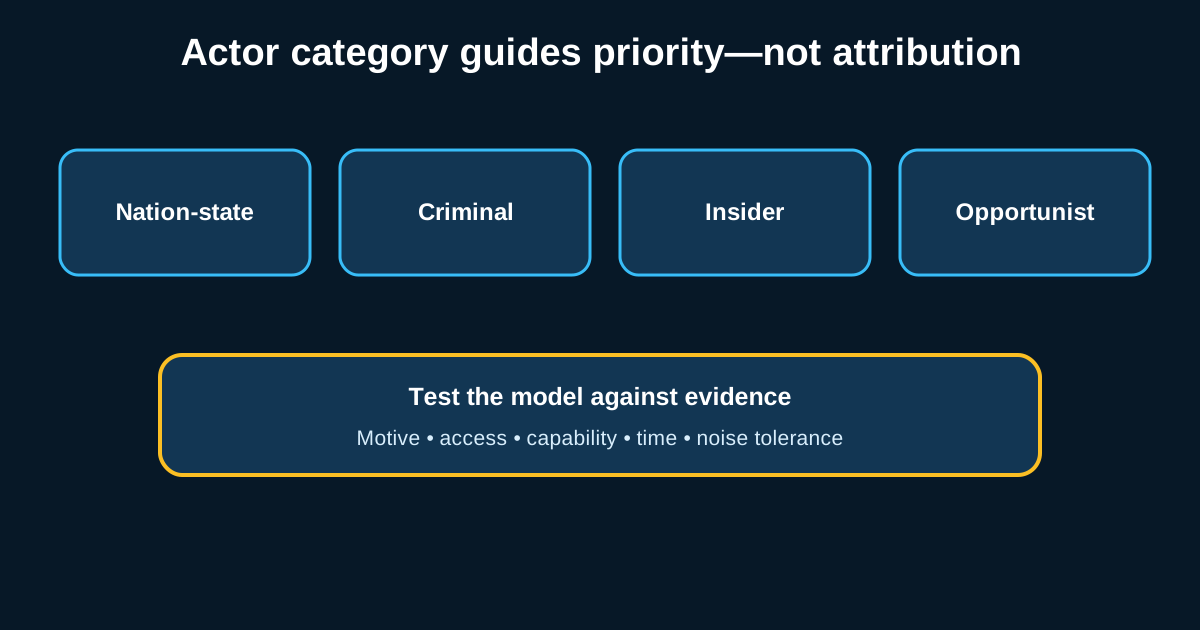
Every hunting hypothesis quietly assumes something about who’s on the other end of it. Hunt for a nation-state implant and you’re thinking patience, custom tooling, low noise. Hunt for a ransomware affiliate and you’re thinking speed, noise tolerance, and a business model that rewards getting to encryption fast. Get the actor category wrong in your head, and you’ll build the wrong hypothesis before you’ve even opened a query window.
That’s really the point of categorizing threat actors not academic taxonomy for its own sake, but making sure your hunt logic matches the behavior you’re actually likely to find.
Nation-State APTs: Patience Is the Whole Point
Advanced persistent threat groups operate with a different clock than everyone else on this list. State-sponsored actors think groups tracked under names like APT28, APT29, or various Chinese-nexus clusters are typically funded, tasked with specific intelligence objectives, and under no real pressure to move fast. A campaign might sit dormant inside a network for months, doing almost nothing that would trip a rule, because the objective is long-term access, not immediate payoff.
This changes what “suspicious” looks like when you’re hunting for this category. You’re not looking for loud, obvious anomalies you’re looking for small deviations sustained over time. Say an APT establishes a foothold using a legitimate remote admin tool already present in the environment, then does nothing detectable for six weeks before a single quiet data staging event. A rule-based detection built for “unusual volume of data transferred” won’t catch a slow trickle spread across weeks. A hunter looking at long-baseline behavioral drift might.
Cybercriminals: Optimizing for Return, Not Stealth
Financially motivated actors ransomware operators, business email compromise crews, banking trojan operators think in terms of return on effort, and that shapes their entire operational tempo. Where an APT might spend weeks on careful reconnaissance, a ransomware affiliate working off an initial access broker’s foothold might go from foothold to domain admin in under 48 hours, because speed to payout matters more than staying invisible for a long campaign.
This category is genuinely the one most SOCs deal with day to day, and it’s also the one where commodity tooling Cobalt Strike, various stealers, off-the-shelf RATs dominates far more than custom malware. A mid-size manufacturing company isn’t likely to be the target of a nation-state implant sitting dormant for a year. It’s far more likely to see a phishing-delivered stealer, followed within days by a ransomware deployment, because that’s the economics of the crime volume and speed over precision.
Insiders: The Category Everyone Underinvests In
Insider threats split into two buckets that need genuinely different hunting approaches malicious insiders acting deliberately, and negligent insiders who create risk without intent. A departing employee exfiltrating client data to a personal cloud account before their last day is a different hunt than an employee who fell for a phishing email and unknowingly authorized a malicious OAuth app.
This category is often underfunded because most SOC tooling is designed to catch external attackers crossing a boundary. Insider activity can look like ordinary use of legitimate access—until context changes the picture. Consider an employee who exports an unusual volume of customer data at 11 p.m. shortly before resigning. The permission is valid; the timing and volume are not. Hypothesis-driven hunting can surface that mismatch even when no clean signature exists.
Hacktivists and Opportunists: Lower Skill, Real Disruption Potential
Less sophisticated but not to be dismissed hacktivist groups and opportunistic attackers scanning broadly for exposed, unpatched systems round out the picture. This category tends toward low sophistication but high volume, exploiting whatever’s easiest rather than targeting a specific organization deliberately. A hunt relevant to this actor type looks less like tracking a specific campaign and more like continuously checking your own external attack surface for the kind of low-hanging exposure an unpatched VPN appliance, an exposed management interface that this category actually goes after.
Building Hypotheses That Match the Actor
The practical takeaway for a hunter: before writing a hypothesis, ask which of these categories is realistically relevant to your organization and this specific hunt. A defense contractor genuinely needs to think about nation-state persistence patterns. A regional retailer’s most realistic risk is commodity ransomware and opportunistic scanning, and building elaborate hunts for nation-state TTPs there is often effort better spent elsewhere. Matching your hunting effort to your actual threat model not the most interesting-sounding actor category is what makes a hunting program efficient instead of just busy.
Build an actor-relevant hypothesis
Choose one important business asset. List who benefits from disrupting, stealing, altering, or quietly accessing it. For the most credible actor, record likely initial access, desired objective, time horizon, and tolerance for noise. Turn only one of those assumptions into a testable hypothesis, and label the remaining assumptions explicitly.
Actor categories are starting models, not attribution. Hunt the observable behavior and use the threat model to prioritize where limited hunting time will reduce the most relevant risk.