Creating Hunt Hypotheses From Risk Analysis
Prioritize threat hunting using business impact, exposure, and threat likelihood instead of whichever report arrived most recently.
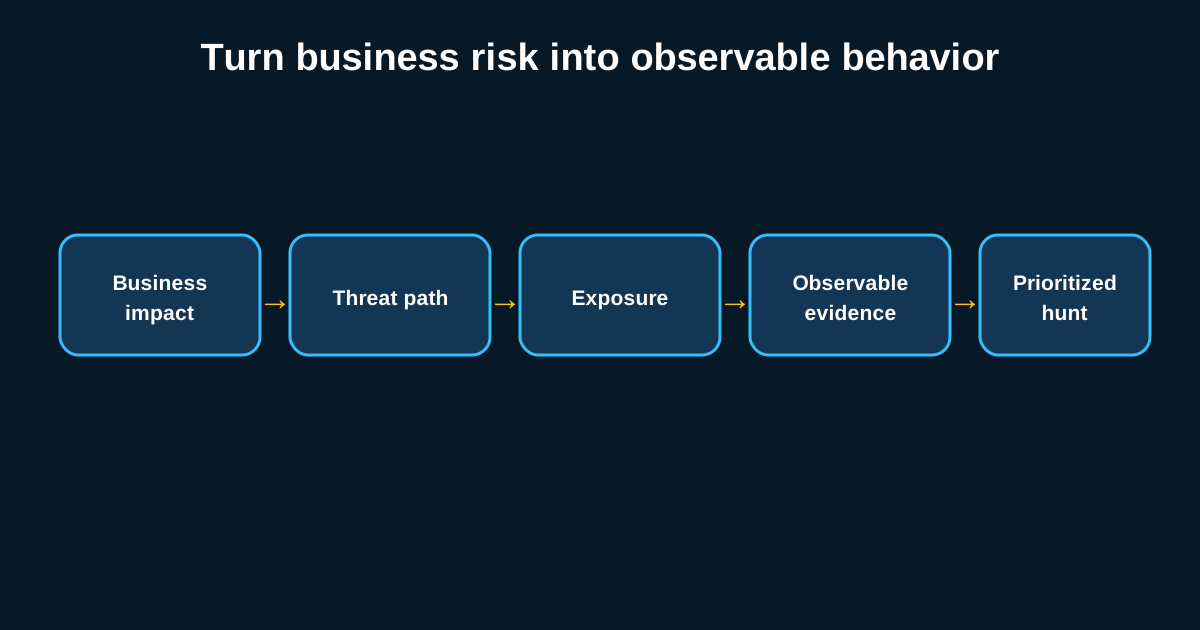
A hunting backlog built entirely from whatever intelligence happened to land this week has a quiet flaw: it’s reactive to the intelligence cycle, not to what actually matters most to your specific organization. Risk-based hypothesis generation flips that around, starting from the question a CFO or a board member would actually ask—what’s the worst plausible outcome for us, specifically, and how likely is it—and working backward into hunts that matter for those exact reasons.
Risk Isn’t the Same Thing as Threat
These two words get used interchangeably a lot, and the distinction matters for hunting priorities. Threat is about capability and intent—is someone out there capable of and interested in doing something bad. Risk factors in impact and likelihood specific to you—even a highly capable, highly motivated actor represents low risk to a specific hunt priority if the asset they’d be going after isn’t actually that valuable or the likelihood of them targeting you specifically is low. A hunting program that chases the scariest-sounding threats without weighing them against actual risk to its own organization ends up hunting for things that make for good conference talks but don’t move the needle on what actually protects the business.
Say your organization holds minimal customer payment data but a huge amount of proprietary manufacturing process documentation. A ransomware group that specializes in payment card theft is a real threat in the abstract, but the risk to you specifically is lower than an industrial espionage actor interested in exactly the intellectual property you’re sitting on—even if the espionage actor gets far less press coverage.
Building a Simple Risk Register Just for Hunting Purposes
You don’t need a full enterprise risk management framework to make this work—a lightweight register purpose-built for hunt prioritization does the job. List your organization’s top eight to ten crown-jewel assets or business processes, and for each, note the plausible threat categories (drawing on the actor landscape piece), an honest likelihood estimate, and the impact if compromised. This doesn’t need to be statistically rigorous—a simple high/medium/low scale across likelihood and impact, multiplied into a rough priority score, is enough to meaningfully reorder a hunting backlog.
Say a mid-size logistics company builds this register and finds that its route-planning and dispatch system, while not the most obviously “sensitive” asset on paper, actually represents the highest combined risk score because a disruption there would halt physical operations within hours—a much faster and more certain business impact than, say, a slower-moving data exfiltration scenario against a less operationally critical system. That register entry alone justifies dedicating disproportionate hunting attention to authentication and access anomalies around the dispatch system, even without any specific intelligence pointing to an active threat against it.
Turning Risk Priorities Into Actual Hunt Hypotheses
A risk register on its own doesn’t hunt anything—it needs the same translation step every other hypothesis source requires. Take your highest-priority risk entry and ask what adversary behavior would actually threaten it, then build a testable hypothesis using the same three-part structure covered earlier: adversary action, expected artifact, scope. For the dispatch system example, a resulting hypothesis might be: “if an attacker gained unauthorized access to the dispatch system’s administrative interface, we’d expect authentication events from accounts or source locations inconsistent with the small group of staff who normally administer it, scoped to the last 90 days.”
This is where risk-based and intelligence-driven hypothesis generation genuinely complement each other rather than compete—risk analysis tells you where to look hardest, and threat intelligence often tells you which specific technique to look for once you’ve decided where. A hunter who’s done the risk work first can read a generic intelligence report and immediately recognize “that technique, applied against our dispatch system specifically, is worth testing” instead of treating every report as equally relevant.
Revisiting the Register on a Real Cadence
Risk isn’t static, and a register built once and never revisited becomes stale faster than people expect—a new acquisition, a new product launch, a shift in what data you’re holding all change the picture. A quarterly review, even a brief one, keeps the register honest and keeps hunting priorities aligned with what the business actually looks like now rather than what it looked like when the register was first drafted.
Avoiding the Trap of Endless Analysis Without Any Hunting
The risk-based approach carries one real failure mode worth naming directly: it’s easy to spend so much time building and refining the register that actual hunting time shrinks to make room for it. Keep the register lightweight and revisit it briefly, not exhaustively—the goal is a working prioritization tool, not a standalone analytical product that becomes its own time sink. If building the register is taking longer than running the hunts it’s meant to prioritize, the scope has crept too far.
Create a risk-to-hunt record
For one business service, document the adverse outcome, important assets, plausible threat behavior, exposure, existing controls, impact, confidence, and available evidence. Score only to support comparison—not to manufacture certainty. Convert the highest credible scenario into one hypothesis and give it an owner and review date.
Risk analysis keeps the hunt backlog connected to consequences the organization cares about. The goal is a defensible priority and a testable behavior, not a perfect number.