What a Hunt Hypothesis Is—and What It Is Not
Learn what separates a testable threat-hunting hypothesis from vague suspicion—and why the distinction determines hunt quality.
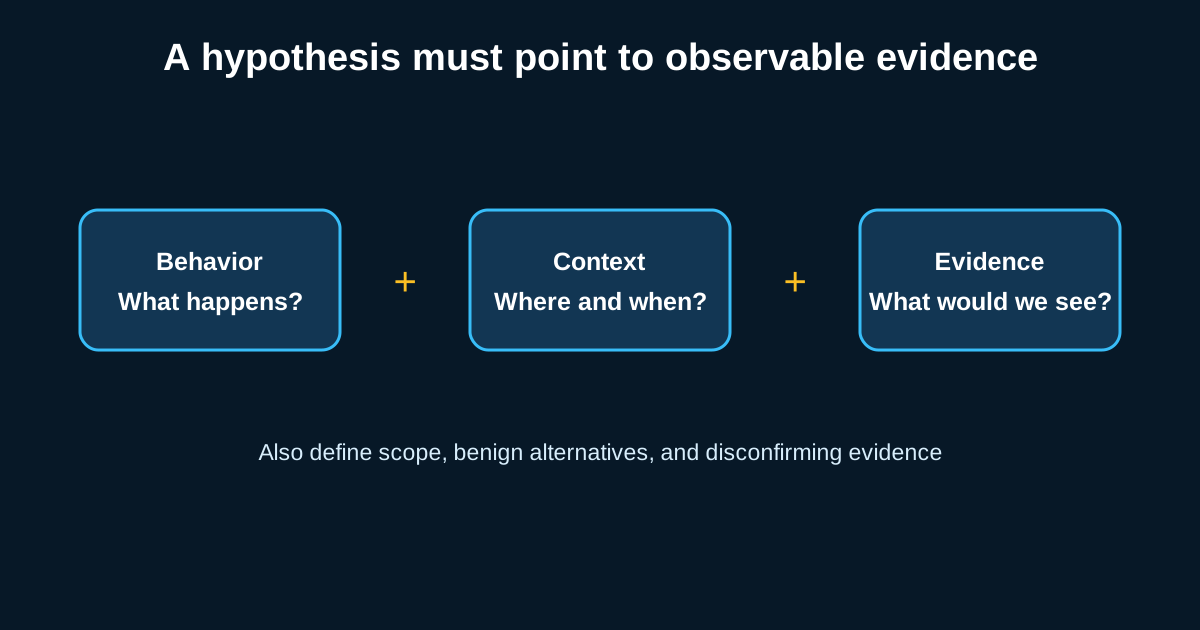
“Let’s check for anything weird on the domain controllers” isn’t a hypothesis. It’s a feeling wearing a hypothesis’s clothes. And a shocking number of hunts start exactly like this—a vague sense that something’s worth looking at, with no clear definition of what “weird” would actually look like or how you’d know when you’re done looking. That vagueness isn’t a minor stylistic issue. It’s the single biggest reason hunts stall out, run forever, or close with a shrug instead of a real answer.
The Difference Is Testability, Not Sophistication
A good hypothesis doesn’t need to sound impressive or reference an exotic technique. It needs to be specific enough that it can fail. “If an attacker established persistence via a malicious scheduled task, we’d expect to see a task creation event with a mismatched task name and binary path” is testable—you can run a query, get a yes-or-no-ish answer, and know when the hunt is actually finished. “Check for persistence mechanisms” is not testable in the same way, because it doesn’t specify what evidence would prove or disprove anything. You could run five different queries under that vague umbrella and never feel confident you’ve actually checked what needed checking.
This distinction—testability over sophistication—means a hypothesis built by a junior analyst working from a basic ATT&CK technique description can be genuinely better structured than a vague, ambitious-sounding hypothesis from a senior hunter who skipped the specificity step. Good hypothesis writing is a discrete skill, separate from raw experience, and it’s one of the more teachable parts of hunting precisely because the structure is learnable independent of deep domain expertise.
The Anatomy of a Testable Hypothesis
A strong hypothesis usually has three components, whether or not the hunter writing it thinks in these explicit terms: an assumed adversary action (what the attacker is hypothesized to have done), an expected artifact (what evidence that action would leave behind, given your specific environment and logging), and a scope (which systems, which time window). Miss any of these three and the hypothesis gets fuzzy in a specific, predictable way.
Miss the adversary action and you’re just browsing data without direction. Miss the expected artifact and you don’t actually know what you’re querying for, even if you know roughly what you’re worried about. Miss the scope and the hunt either runs forever across too much data, or accidentally excludes the systems where the activity would actually be found. Say a hypothesis states “check for lateral movement” without specifying scope—a hunter might spend hours pulling data from every host in a 5,000-endpoint environment when the actual concern was specific to a single business unit’s file servers.
Where Vague Suspicion Actually Comes From (And What to Do With It)
Vague suspicion isn’t worthless—it’s often the honest starting point for a real hypothesis, and pretending otherwise is its own mistake. An analyst’s gut sense that “something feels off about how that service account has been behaving” is a legitimate seed. The skill is in the next step: pushing that feeling until it becomes specific. What, exactly, feels off? Is it the timing, the volume, the systems accessed, the combination of all three? Once you can answer that, you’ve got the raw material for a real hypothesis, even if the original instinct was fuzzy.
A useful habit: whenever a vague suspicion shows up, force yourself to write one sentence completing “if this suspicion is correct, I would expect to see __ in __ data source.” If you can’t fill in that blank with something specific, the suspicion isn’t ready to become a hunt yet—it needs more thinking, or more information, before it’s worth spending hunt time on.
Hypotheses Can Be Wrong—That’s Not a Failed Hunt
A hypothesis that gets disproven cleanly is a successful hunt, not a failed one, and this distinction matters more than it sounds like it should. If your hypothesis was “we’d see X evidence if this technique occurred” and the query comes back clean, with confidence that the data collection was actually adequate to have caught it, that’s a genuine, useful answer—you’ve ruled something out with evidence, rather than just assuming you’re fine because nothing alerted. Treating a “no” result as wasted effort, rather than as a legitimate finding worth documenting, is a mindset problem that quietly discourages hunters from testing hypotheses that might not pan out, which is exactly the wrong incentive for a discipline that’s supposed to be exploratory.
Practicing the Skill Specifically
Writing sharp hypotheses is a skill that improves with deliberate repetition, separate from general security knowledge—plenty of experienced analysts with deep technical knowledge still write mushy, untestable hypotheses out of habit, simply because nobody made them practice the specific discipline of tightening one before running it. A useful exercise: take five vague hunting ideas you’ve had recently and rewrite each one with the three components above made explicit, before ever touching a query.
Use the five-question test
Can you name the behavior, environment or target, expected evidence, search scope, and evidence that would weaken the idea? If any answer is missing, refine the hypothesis before querying. “Hunt for PowerShell” is a topic; “PowerShell launched by an Office process and making a first-seen external connection on employee endpoints” is testable.
A good hypothesis narrows uncertainty. It tells another analyst what evidence to seek and allows a negative result to mean something within a clearly stated scope.