Hunting Ransomware Across Every Phase of the Attack
Understanding ransomware-as-a-service operations phase by phase, and where each stage gives a hunter a real chance to catch it early.
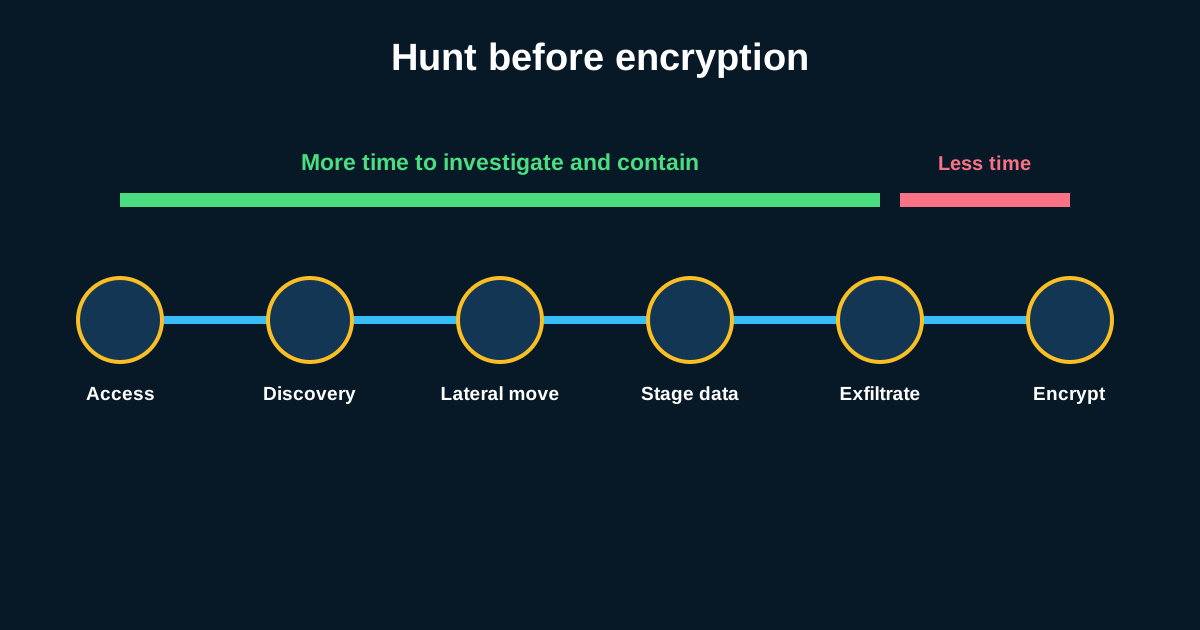
By the time a ransom note shows up on a screen, the hunt already lost. That’s not defeatism it’s the actual math of ransomware operations. Encryption is the final, loudest, least interesting step from a hunting perspective, because everything that made the attack succeed happened days or weeks earlier, mostly quietly, and mostly in ways that leave real evidence if you know where to look.
The RaaS Business Model Changes What You’re Hunting For
Ransomware-as-a-service split the old “one group does everything” model into specialized roles initial access brokers who sell footholds, affiliates who buy that access and run the actual intrusion, and RaaS operators who provide the encryption tooling and leak-site infrastructure in exchange for a cut. This matters for hunting because it means the initial access technique and the final encryption technique are frequently produced by entirely different actors with different skill levels, so a single campaign can show sophisticated initial access alongside fairly generic, template-driven post-exploitation behavior.
Practically, this means you shouldn’t assume consistency across an intrusion’s lifecycle. A highly targeted, well-crafted phishing lure at initial access doesn’t mean the lateral movement that follows will be equally sophisticated often it’s the opposite, because the affiliate running post-access operations is working from a fairly standardized playbook regardless of how the initial foothold was obtained.
Initial Access: The Highest-Leverage Phase to Hunt
Initial access phishing, exploited VPN appliances, purchased access from a broker is where hunting has the most leverage, because everything downstream compounds from here. A hunt hypothesis worth running regularly: check for successful authentication events on remote access infrastructure (VPN, RDP gateways) from source IPs or geographies inconsistent with the account’s normal pattern, especially for accounts with elevated privileges. Say your VPN logs show a service account authenticating successfully from a residential IP range in a country that account has never connected from that’s exactly the kind of anomaly that’s cheap to hunt for and catches access broker activity before an affiliate even shows up.
Discovery and Lateral Movement: Where the Noise Actually Happens
Once inside, ransomware affiliates typically move faster and louder than an APT would, because the economic model rewards speed over stealth dwell time in a ransomware intrusion is often measured in days, not months. This phase generates real telemetry: network scanning tools, credential dumping via LSASS access, use of legitimate admin tools like PsExec or WMI for lateral movement, often at a volume and pace that looks distinctly different from normal IT operations.
A hunt here benefits from comparing tempo, not just presence. Legitimate IT admins use PsExec too but rarely across forty hosts in a two-hour window from a single account that isn’t normally associated with bulk administrative activity. Hunting for volume and timing anomalies in legitimate admin tool usage catches more ransomware lateral movement than hunting for the tools themselves, since the tools are almost never inherently malicious.
Staging and Exfiltration: The Phase Detection Often Misses
Modern ransomware operations frequently exfiltrate data before encrypting it, as leverage for double-extortion pay or we publish. This staging phase involves compressing and moving large volumes of data to external infrastructure, often cloud storage or file-sharing services, and it happens before the loud, obvious encryption event. A hunt hypothesis worth prioritizing: unusual outbound data volume to cloud storage or file transfer services from hosts that don’t normally initiate that kind of traffic, particularly clustered around off-hours.
This phase deserves more hunting attention than it typically gets, because most organizations’ detection stacks are tuned to catch encryption behavior mass file modification patterns rather than the exfiltration that usually precedes it by hours or days. Catching staging and exfiltration gives you a window to respond before encryption ever happens, which is a fundamentally better outcome than a fast IR response to an already-encrypted environment.
Building Hunts Around Phase, Not Just Malware Family
The practical shift for a hunting program: stop organizing ransomware hunts around specific malware family names, which rotate constantly as RaaS branding changes, and start organizing them around phase-specific behavior initial access anomalies, lateral movement tempo, staging volume patterns. Say a program runs a rotating monthly hunt hypothesis cycling through these three phases rather than reacting to whatever ransomware family made headlines that week. That structure stays relevant even as the specific RaaS brands and affiliate groups shift underneath it, which they do constantly.
Build a phase-based hunt plan
For initial access, discovery, lateral movement, staging, exfiltration, and impact, write one observable behavior, one required data source, one likely benign explanation, and one escalation threshold. Start with the earliest phase your telemetry can support. Earlier evidence usually provides more time to investigate and contain.
Encryption is the outcome, not the whole intrusion. Durable ransomware hunting follows the sequence of access, expansion, collection, and disruption—regardless of the brand used at the final stage.