Studying Real APT Campaigns for Hunt-Ready Intelligence
How to study documented APT campaigns and extract genuinely hunt-relevant intelligence, instead of just admiring the sophistication.
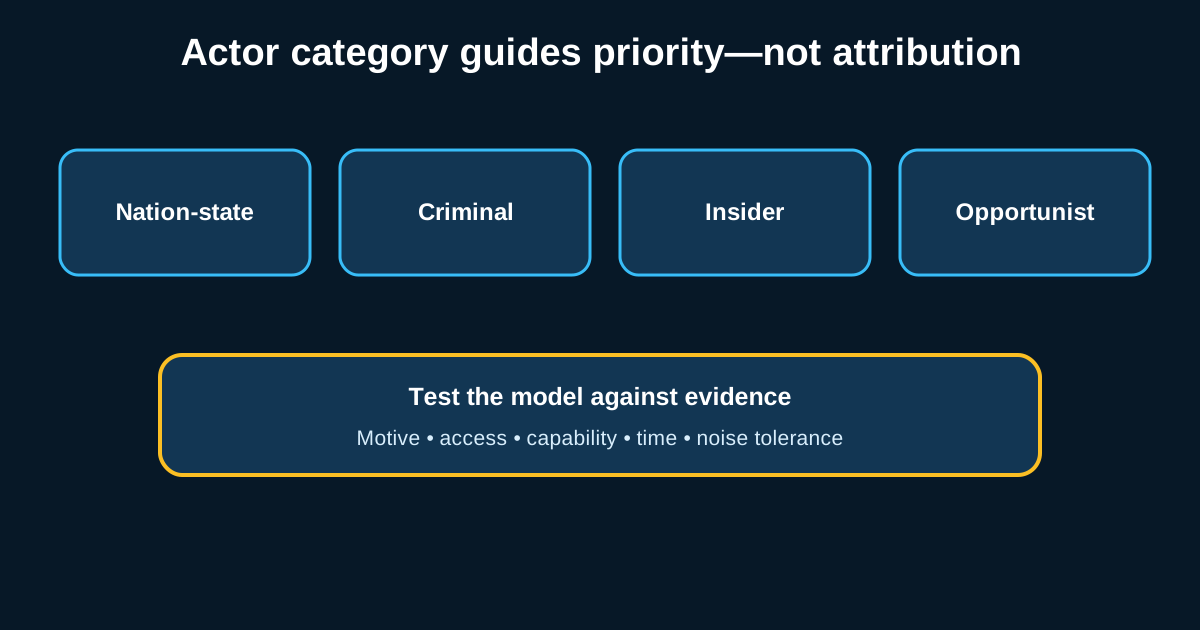
Reading an APT campaign writeup for entertainment and reading it as a hunter are two completely different exercises, even though they involve the same document. The entertainment version focuses on the clever bits the novel exploit chain, the elaborate infrastructure. The hunter’s version asks a narrower, less glamorous question: what would this campaign have actually looked like in my logs, and would I have caught it?
Fancy Bear and the Long Game of Credential Access
APT28, publicly tracked under names including Fancy Bear, has a well-documented pattern of persistent credential-focused operations against government and military targets, often starting with spearphishing that leads to credential harvesting rather than immediate malware deployment. The hunt-relevant lesson here isn’t the specific phishing lure lures change constantly and chasing the exact wording is a losing game. It’s the pattern underneath: credential harvesting followed by a period of legitimate-looking authentication using those stolen credentials, sometimes for extended periods before any other malicious activity becomes visible.
For a hunter, this translates into a hypothesis that doesn’t depend on catching the phishing email at all you’re instead hunting for authentication anomalies downstream of a hypothetical successful phish. For example, imagine a hunt pulls authentication logs looking for accounts that show a sudden change in typical access pattern new source geography, new set of resources accessed without any corresponding password reset or account provisioning event. That gap, credentials in use without a legitimate reason for the access pattern to have changed, is the durable signature, independent of whatever specific lure got the credentials stolen in the first place.
Lazarus Group and the Blend of Financial Crime and Espionage
Lazarus Group is publicly documented as operating across an unusually wide range from destructive attacks and espionage to financially motivated operations, including cryptocurrency theft campaigns that have moved substantial sums through elaborate laundering chains. What makes this group instructive for hunters is precisely that range: the same actor cluster showing both nation-state patience and cybercriminal urgency depending on the operation’s goal, which breaks the clean actor-category boxes discussed in threat landscape overviews.
The hunt-relevant takeaway here is about not over-indexing on actor attribution during an active investigation. If you’re mid-hunt and behavior looks like commodity financial crime, don’t assume that rules out a more sophisticated actor some of the most well-resourced groups deliberately operate financially-motivated campaigns that look, on the surface, exactly like ordinary cybercrime. Attribution matters for strategic intelligence and reporting. It matters much less for the actual hunt hypothesis, which should be built around observed behavior rather than a premature guess about who’s behind it.
Extracting TTPs Instead of IOCs
The single biggest mistake in translating APT reporting into hunting value is treating the report as an IOC list to check against pull the IP addresses and file hashes mentioned, run them against your environment, call it a hunt. That’s IOC-driven hunting, and it has genuine but narrow value: it only catches this exact campaign, using this exact infrastructure, which the actor will have rotated by the time the report’s public anyway.
The better extraction is TTP-level: what technique, independent of specific infrastructure, does the campaign rely on. A report describing use of a legitimate cloud storage service for command-and-control isn’t useful because of the specific bucket name mentioned that’s gone already. It’s useful because it tells you “check for outbound connections to cloud storage services from hosts that have no legitimate business reason to use them,” which stays relevant long after the specific campaign infrastructure has rotated three times over.
Building a Reusable Hunt From a One-Time Report
A practical habit worth building: every time you read a substantive APT campaign report, pull out exactly one durable hypothesis from it something you could actually test against your own environment, independent of the specific IOCs mentioned. Say a report on a campaign attributed to a nation-state actor describes use of scheduled tasks disguised with names matching legitimate system maintenance jobs for persistence. The reusable hypothesis: “hunt for scheduled tasks whose names closely resemble known system task naming conventions but whose associated binary paths fall outside expected system directories” a hypothesis that survives long after this specific campaign is old news, and one that’s genuinely testable against your own scheduled task creation logs.
Reading Reports Slower, Getting More Out of Them
It’s tempting to skim these reports for the headline finding and move on. Slowing down enough to ask “what would this look like in my logs specifically” on two or three sections of a report not the whole thing, that’s exhausting and not necessary turns a report you read once into a hypothesis you can actually run. Most hunters who build a strong intuition for this do it by repetition: reading enough campaign reports with this specific lens that pulling out the durable TTP becomes close to automatic.
Use a campaign extraction worksheet
For each report, capture: claimed actor, publication date, observed period, victim context, access method, techniques, tools, infrastructure, affected platforms, required telemetry, and source confidence. Select one behavior that is both relevant locally and visible in your data. Write a hypothesis that describes the behavior without depending on the report’s actor label.
A campaign report becomes hunt-ready when you can describe what the behavior would look like in your own telemetry, what benign activity resembles it, and what evidence would change your confidence.