AI and Threat Hunting: Augmentation, Not Replacement
AI will transform how threat hunters work, but it cannot replace the human judgment, intuition, creativity, business context, and decision-making that make threat hunting effective.
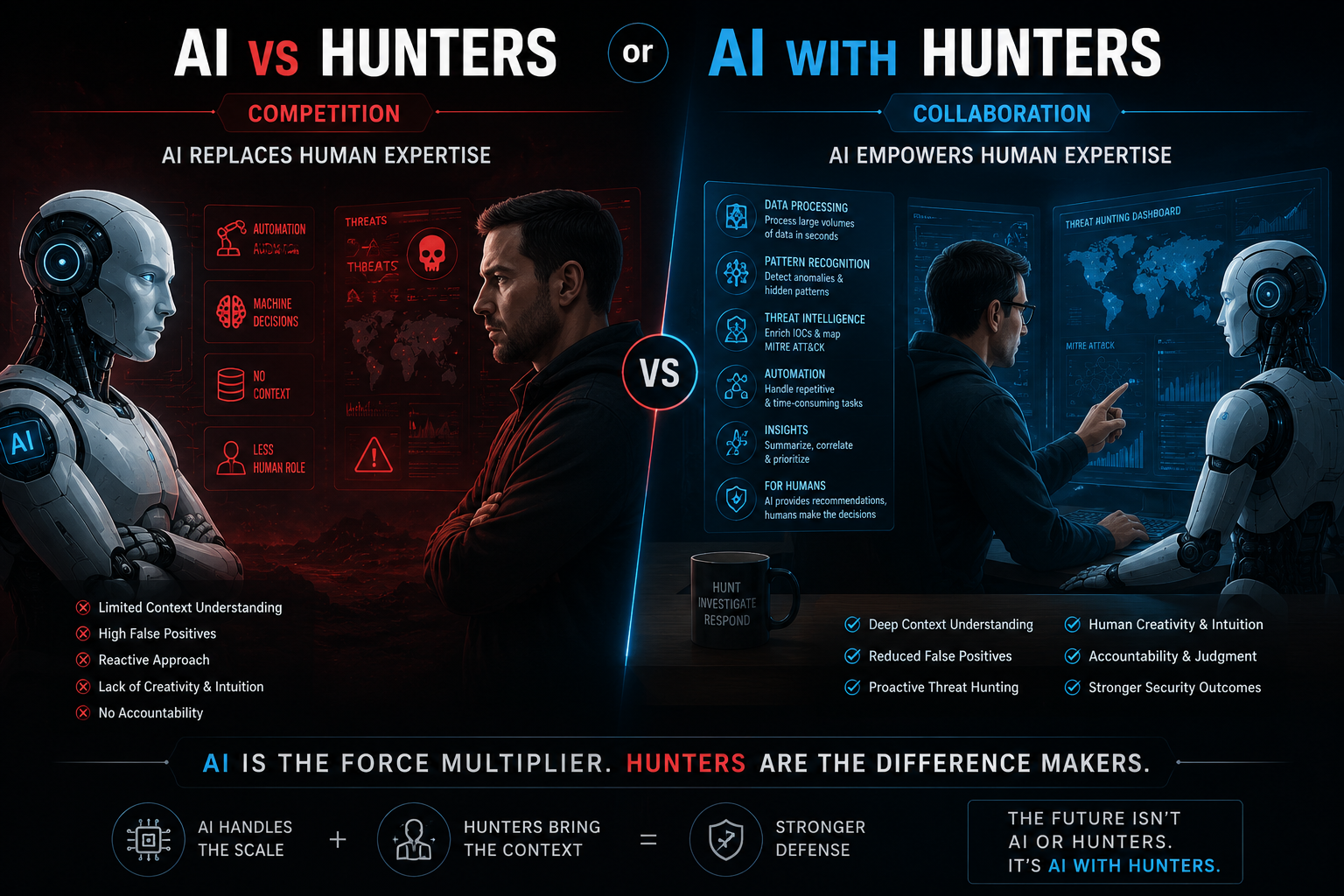
AI and Threat Hunting: Augmentation, Not Replacement
Every few years, a new technology walks into the security industry and someone declares that it will make analysts obsolete. It happened with SIEM automation. It happened with SOAR playbooks. It happened with UEBA. And now it’s happening again with AI except this time the noise is louder, the claims are bigger, and the anxiety in SOC Slack channels and LinkedIn comment sections is real.
If you’re a SOC analyst, detection engineer, or threat hunter reading yet another “AI will change everything” article, I get the skepticism. You’ve heard variations of this pitch before, usually from a vendor trying to sell you a platform. So let’s set expectations early: this article is not going to tell you that AI is about to replace threat hunters. It isn’t. What it’s going to do is walk through the actual mechanics of threat hunting stage by stage and show you honestly where AI genuinely helps, where it falls short, and why the two together will outperform either one alone.
Why Everyone Is Suddenly Talking About AI in Security
Large language models and machine learning tooling have gotten dramatically better at a specific set of tasks: summarizing large volumes of text, recognizing patterns across messy data, generating and explaining code, and holding something resembling a conversation about technical material. Those capabilities map naturally onto a lot of the grunt work in a SOC reading through thousands of log lines, explaining an obfuscated PowerShell one-liner, drafting a report after a long investigation. It’s no surprise that vendors and practitioners alike are excited.
But excitement has a way of curdling into fear when it’s framed as a replacement narrative instead of a productivity narrative. And that fear isn’t irrational it’s grounded in real history. Automation has reshaped security operations before.
Think about what a SOC analyst’s job looked like before SIEM correlation rules, before SOAR playbooks, before automated enrichment pipelines. Analysts used to manually cross-reference IP addresses against blocklists, manually pull logs from a dozen systems, manually build timelines by hand. Automation absorbed nearly all of that work. And yet SOC teams didn’t shrink into irrelevance the job shifted. Analysts spent less time on mechanical lookups and more time on judgment calls: is this activity actually malicious, does it matter for this business, what should we do about it.
AI is the next iteration of that same pattern, but it’s being applied to a different, more cognitively demanding layer of the work. That’s exactly why threat hunting deserves a more careful conversation than “will AI take my job.”
Why Threat Hunting Is Different From Automated Detection
Detection engineering and threat hunting often get lumped together, but they solve different problems. Detection engineering is about building rules and analytics that catch known-bad or known-suspicious patterns reliably, at scale, with acceptable false-positive rates. It’s inherently well suited to automation because it’s rule-based and repeatable.
Threat hunting exists precisely because detection has limits. You hunt because you assume an adversary is already inside your environment, operating below the threshold of your existing detections, blending into normal business activity. There’s no rule to trigger because, by definition, you haven’t written that rule yet you don’t know exactly what you’re looking for. You’re operating on a hypothesis, incomplete information, and judgment.
That distinction matters enormously when you’re evaluating what AI can and can’t do here. A system that’s excellent at matching known patterns is not automatically good at generating novel hypotheses about an adversary it has never seen, in an environment it doesn’t understand, against business context it has no access to. AI changes how threat hunters do their job. It does not change whether threat hunters are needed. That’s the thesis of this entire piece, and we’re going to prove it by walking through the actual threat hunting lifecycle.
What Threat Hunting Actually Is (And What It Isn’t)
If you ask ten people outside the field what threat hunting is, most will say something like “searching logs for bad stuff” or “writing KQL and Sigma rules to find attackers.” That’s not wrong, exactly, but it badly understates the discipline. Query languages and detection rules are tools threat hunters use they are not the job itself.
Threat hunting, done properly, is a cognitive and investigative discipline built from several distinct skills working together:
- Understanding attacker behavior knowing how real adversaries operate, not just what a signature looks like.
- Understanding the defender’s environment knowing what’s normal for this specific organization, this specific network, these specific users.
- Forming hypotheses deciding what to look for and why, before you start looking.
- Collecting and correlating evidence pulling the right data from the right sources and connecting it meaningfully.
- Validating assumptions constantly asking “am I actually seeing what I think I’m seeing?”
- Adapting as new findings emerge a hunt rarely ends where it started; good hunters follow the evidence.
- Making decisions under uncertainty deciding when something is a real threat versus an oddity versus nothing at all, often without complete information.
- Documenting findings turning an investigation into something the rest of the organization can act on.
- Improving detection feeding what was learned back into the detection engineering pipeline so the next occurrence doesn’t require a manual hunt at all.
That’s a lot of moving parts, and most of them involve judgment rather than pattern matching. Keep that list in mind we’re going to revisit each of these threads as we walk through the lifecycle stage by stage.
The Threat Hunting Lifecycle: Where AI Helps and Where Humans Remain Essential
Stage 1: Understanding the Problem
Before a hunter writes a single query, they need to understand what they’re actually hunting for and why it matters. This means digesting threat intelligence vendor reports, ISAC bulletins, government advisories, dark web chatter and translating it into something operationally relevant. It means understanding attacker objectives: is this campaign about ransomware deployment, data theft, espionage, or access resale? And it means understanding business impact and environmental context: does this organization even run the software this campaign targets? Is the affected business unit high-value or low-value from a risk perspective?
How AI helps: This is genuinely one of AI’s strongest contributions to the hunting process. Large language models are very good at digesting a 40-page threat intelligence report and producing a concise summary. They can extract indicators of compromise (IPs, hashes, domains, file names) from unstructured text far faster than a human skimming line by line. They can map described techniques to MITRE ATT&CK identifiers, and they can pull up structurally similar campaigns from historical data if given access to it. What used to take a threat intel analyst an hour of reading and note-taking can often be compressed into minutes of review and verification.
Why humans remain essential: None of that intelligence means anything without organizational context. A campaign targeting healthcare EHR systems is irrelevant noise to a manufacturing company and existential risk to a hospital. Only a human with knowledge of the business its crown-jewel assets, its regulatory obligations, its risk appetite, its current threat landscape can decide which of the hundred intelligence reports that land in an inbox each week actually deserve a hunt. AI can tell you what a campcampaign does. It can’t tell you whether your CFO would lose sleep over it.
Stage 2: Creating Hunt Hypotheses
Hypothesis-driven hunting is the backbone of a mature program. Instead of aimlessly searching logs, a hunter formulates a specific, testable statement: “I believe an adversary may be using WMI for lateral movement in our finance segment,” or “I believe there may be undetected persistence via scheduled tasks on domain controllers following the recent phishing campaign,” or “I believe service account credentials may be used outside of normal business hours in a way that indicates compromise.”
How AI helps: Given a body of threat intelligence, environmental notes, and prior hunt history, AI can suggest candidate hypotheses and surface related ATT&CK techniques a hunter might not have immediately considered. It can search through historical hunt documentation to check whether a similar hypothesis has already been tested (and what the outcome was), preventing duplicated effort. It’s also useful for pressure-testing a hypothesis asking “what assumptions am I making here that I haven’t validated?” and getting back a reasonable checklist.
Why humans remain essential: Generating a list of plausible hypotheses is the easy part. Deciding which three of the fifteen suggested hypotheses are actually worth a hunter’s next two days of work requires prioritization judgment grounded in business risk, resource constraints, and institutional memory (“we already ruled that out last quarter, but for a different reason than the AI thinks”). That prioritization call and the investigative direction that follows from it remains a human decision.
Stage 3: Identifying Data Sources
Once a hypothesis is set, the hunter has to figure out which telemetry sources will actually let them test it. In a modern enterprise that could mean pulling from VPN logs, firewall logs, EDR telemetry, DNS resolution logs, proxy logs, authentication and identity provider logs, Active Directory event logs, cloud provider audit logs (AWS CloudTrail, Azure Activity Log, GCP Audit Logs), email security gateway logs, network flow data, container runtime logs, Kubernetes audit logs, and SaaS application logs.
How AI helps: AI tooling is genuinely useful here for suggesting which telemetry sources are typically relevant to a given technique for example, recommending that a hypothesis about Kerberoasting should pull from domain controller security event logs (Event ID 4769) rather than just EDR process telemetry. It can also help a less experienced hunter quickly learn what data sources map to which ATT&CK techniques, effectively acting as a knowledge accelerator.
Why humans remain essential: Knowing a source should exist in theory is very different from knowing whether that source is actually reliable in your environment. Experienced hunters know that “we have DNS logs” doesn’t mean much if retention is seven days, if a third of endpoints route through a proxy that strips the source IP, or if that particular log source has a known parsing bug that drops 15% of events during peak load. That kind of environmental and data-quality knowledge lives in the heads of people who’ve been burned by it before it’s not something AI can infer without being told, and even then it’s easy to miss nuance that only comes from experience with the actual infrastructure.
Stage 4: Data Collection
With data sources identified, the hunter (often working with data engineers) needs to pull the data together in a usable form: querying APIs, normalizing disparate log formats into a common schema, parsing unstructured fields, correcting timestamp discrepancies (timezone mismatches are a perennial headache), enriching records with context like geolocation or asset ownership, and deduplicating redundant events.
How AI helps: This is largely mechanical work, and AI-assisted automation is well suited to it. AI can help generate parsing logic for messy or nonstandard log formats, propose schema mappings between disparate sources, flag likely timestamp anomalies, and even write the enrichment scripts that pull in asset context or threat intel matches. This is one of the clearest efficiency wins in the entire lifecycle hours of tedious data wrangling reduced to a fraction of the time.
Why humans remain essential: Someone still has to validate that the normalization logic didn’t silently drop or mangle data, that an automated timestamp “correction” didn’t actually introduce an error, and that enrichment sources are trustworthy. Data collection failures are often invisible until they cause a missed detection during an actual hunt a human has to be the check on that risk.
Stage 5: Investigation
This is the heart of threat hunting, and it’s where AI’s contribution is broadest and most visible.
Once data is collected, the hunter is doing dense analytical work: building timelines of activity across multiple systems, correlating entities (a user account, a host, a process, an IP address) across log sources, correlating identity activity across on-prem and cloud identity providers, making sense of PowerShell and command-line arguments that were deliberately obfuscated, understanding what a piece of malware or a suspicious binary is actually doing, decoding Base64 or other encoded payloads, interpreting scripts written in unfamiliar languages, spotting patterns and anomalies buried in large datasets, clustering similar events together, summarizing behavior across a long session of activity, writing the actual hunt queries in KQL, SPL, or whatever query language the environment uses, enriching IOCs against threat intel sources, mapping observed behavior to MITRE ATT&CK, and scoring the relative risk of different findings.
How AI helps and this deserves emphasis: This is genuinely where modern AI tooling shines in threat hunting, and it’s worth being specific about why.
- Explaining obfuscated commands. A hunter finds a heavily obfuscated PowerShell command with string concatenation, character code substitution, and Base64-encoded payloads nested three layers deep. Manually deobfuscating that by hand can take twenty minutes. An AI model can walk through the deobfuscation step by step and explain what the resulting command actually does in seconds, which the hunter then verifies.
- Malware and script explanation. Reading through an unfamiliar script a piece of JavaScript, a VBA macro, a Python payload to understand its intent is slow, careful work. AI can produce a first-pass explanation of what the code does, which functions are suspicious, and which known techniques it resembles, giving the hunter a head start rather than a blank page.
- Timeline and entity correlation. Given structured event data, AI can help stitch together a coherent narrative “this user authenticated from this IP, then this process spawned, then this outbound connection occurred” far faster than a hunter manually cross-referencing spreadsheets.
- Query generation. Translating a hypothesis in plain English into a working KQL or SPL query, especially for less experienced hunters, saves real time and reduces syntax friction, especially across a team using multiple query languages.
- Pattern recognition and clustering across large datasets. ML-based clustering can surface groups of similar events that share subtle characteristics a human would struggle to spot manually across millions of rows a genuinely valuable form of automated pattern recognition, distinct from generative AI, that has been used in security analytics for years and continues to improve.
The net effect of all of this is a significant reduction in investigation time on the mechanical and explanatory portions of a hunt the parts that used to eat hours of an experienced analyst’s day just to get to the point where real judgment could be applied.
Why humans remain essential: Every one of those AI outputs is a draft, not a verdict. An AI’s explanation of an obfuscated command can be wrong subtly or completely and a hunter who accepts it uncritically can walk away with an incorrect understanding of what actually happened. AI-generated timelines can be internally consistent and still miss the one event that didn’t fit the pattern, because the model wasn’t looking for it. Query generation still requires a hunter who understands the schema well enough to know if the AI-generated query is actually testing the hypothesis it claims to test, or subtly missing edge cases. The investigative “smell test” the moment where an experienced hunter looks at a result and thinks “that doesn’t feel right, let’s dig one layer deeper” is intuition built from years of pattern exposure, and it’s exactly the thing that catches AI’s mistakes before they become false conclusions.
Stage 6: Human Validation
Not everything unusual is malicious. A huge portion of threat hunting time is spent distinguishing genuinely suspicious activity from things that merely look suspicious out of context: authorized penetration testing, scheduled maintenance windows, approved architectural changes, documented business exceptions, quirky-but-legitimate behavior from legacy systems that nobody’s gotten around to decommissioning, or tribal knowledge like “that server always talks to that weird IP because it’s a vendor’s monitoring appliance, we approved it in 2021.”
Why AI cannot reliably do this: None of that information typically lives in the logs. It lives in change management tickets, in Slack threads from three years ago, in the memory of the network engineer who’s been there since before the current SOC team existed. AI has no access to that institutional memory unless someone explicitly feeds it in, and even then, “explicitly feeding in” every piece of tribal knowledge that might be relevant to every hunt is not realistic. This is precisely why human validation is a non-negotiable stage the threat hunter is the check that separates statistically unusual from actually dangerous.
Stage 7: Decision Making
Once a hunter has a validated finding, decisions have to be made: do we contain this host now, or do we continue monitoring to gather more evidence first? Do we escalate to incident response? Is this a false positive worth tuning out, or a true positive worth acting on? What’s the business risk of disrupting this system versus leaving it running while under investigation? Are there legal or regulatory considerations breach notification obligations, evidence preservation requirements that affect how we proceed? What’s the blast radius if we’re wrong in either direction?
Why this stays human, categorically: These decisions carry real consequences and real accountability. Someone has to be answerable for the choice to isolate a production system that might cost the business money if it’s a false alarm, or the choice not to isolate a system that turns out to be genuinely compromised. That accountability cannot be delegated to a model not because AI is incapable of producing a recommendation, but because organizations, regulators, and courts don’t currently recognize an AI system as a responsible party. A human has to own the decision, which means a human has to be the one making it, informed by AI input rather than replaced by it.
Stage 8: Reporting
After the investigation concludes, findings need to be documented and communicated to different audiences: a detailed technical report for the SOC and detection engineering team, an executive summary for leadership that translates technical findings into business risk language, a MITRE ATT&CK mapping of the observed techniques, a clear timeline of events, and concrete recommendations for remediation and future detection.
How AI helps: This is another strong use case. AI is well suited to turning a hunter’s raw notes, query outputs, and findings into a structured first draft of a report technical writeups, executive summaries pitched at the right level of abstraction, ATT&CK mappings formatted consistently, and timelines laid out clearly. This can meaningfully cut down the time hunters spend on the least enjoyable part of the job: writing it all up after the interesting work is done.
Why humans remain essential: A hunter still needs to review the draft for factual accuracy, make sure nothing sensitive is mischaracterized, ensure the executive summary reflects actual business risk rather than a generic restatement of technical severity, and add the judgment calls and recommendations that only someone who lived through the investigation can make credibly.
Being Honest About AI’s Limitations
It’s easy for an article like this to slide into a soft version of hype “AI can’t fully replace you, but it’s basically magic for everything else.” That’s not accurate either, and it’s worth being specific about why AI has real limitations in this domain, not just listing them.
Hallucinations. Language models generate the most statistically plausible next output, not necessarily the correct one. When explaining a piece of malware or deobfuscating a command, a model can produce an explanation that sounds authoritative and coherent but is factually wrong inventing a function’s purpose, misreading a hex value, or describing behavior the code doesn’t actually exhibit. This is dangerous precisely because the output reads as confident, and a rushed or inexperienced hunter can mistake fluency for correctness.
Incorrect assumptions. Models trained on general or public data make assumptions based on what’s typical, not what’s true in your specific environment. A behavior that’s a red flag in a typical enterprise might be completely normal in yours, and vice versa and the model has no way of knowing which unless told explicitly.
Limited business context. As covered throughout the lifecycle, AI systems generally don’t have access to the full web of organizational knowledge asset ownership, business priorities, risk tolerance, regulatory obligations that shapes almost every meaningful decision in a hunt.
Missing telemetry blind spots. AI can only reason about the data it’s given. If a critical log source is missing, delayed, or was never collected, the model won’t necessarily flag the gap as a limitation it will simply produce an answer based on incomplete information, and that answer can look just as confident as one built on complete data.
Bias in training data and historical patterns. If a model has been trained or tuned on historical attack patterns, it will naturally be better at recognizing things that resemble what it has seen before, and comparatively weaker at recognizing genuinely novel attacker tradecraft that doesn’t fit prior patterns which is precisely the kind of activity skilled adversaries try to produce.
Overconfidence. Related to hallucination but distinct: even when a model’s underlying reasoning is shaky, its output tone tends to be assertive. There’s rarely a built-in signal of “I’m 40% confident in this” versus “I’m 95% confident in this” unless a system is specifically designed to convey that, which most current tooling doesn’t do well.
Novel attacks and lack of intuition. Skilled adversaries deliberately try to avoid known patterns. Recognizing a genuinely new technique one that doesn’t map cleanly to prior ATT&CK entries or historical campaigns often requires the kind of intuitive leap that comes from years of hands-on exposure to attacker behavior, not statistical pattern matching against a training set.
Lack of creativity in adversarial thinking. Good threat hunters sometimes succeed by thinking like an attacker imagining a novel abuse of a legitimate feature, or a creative combination of techniques nobody has documented yet. That kind of generative, adversarial creativity is a different capability from summarizing known patterns, and it remains a distinctly human strength.
Dependency on training data recency. Threat landscapes move fast. A model’s knowledge is only as current as its training data (and whatever live context it’s given), so relying on it as a sole source for “what’s the latest attacker tradecraft” without supplementing it with current threat intelligence is a real risk.
None of this means AI is unreliable to the point of uselessness it means AI output needs the same scrutiny a hunter would apply to any other unverified lead. Treat it as a fast, occasionally brilliant, occasionally wrong junior analyst not as an oracle.
Threat Hunting Activity: AI vs. Human Capability
| Threat Hunting Activity | AI Capability | Human Capability |
|---|---|---|
| Reading and summarizing large log volumes | Excellent fast, consistent, tireless | Slower, but catches subtle context AI misses |
| Correlating events across data sources | Strong, especially at machine scale | Strong, with added environmental judgment |
| Hypothesis generation | Good at surfacing candidate ideas | Essential for prioritizing and validating relevance |
| Business context and risk framing | Weak lacks organizational knowledge | Strong this is core human territory |
| Creative, adversarial thinking | Limited tends toward known patterns | Strong can imagine novel attacker behavior |
| Decision making (containment, escalation) | Not appropriate no accountability | Required carries responsibility and consequence |
| Risk assessment | Can support with data, not own the judgment | Strong weighs business, legal, operational risk |
| Threat modeling | Can assist with technique mapping | Strong requires environmental and strategic insight |
| Report writing and documentation | Strong first draft, fast | Strong refines accuracy, tone, and judgment |
| Explaining obfuscated code/commands | Strong, fast first-pass explanation | Required to verify accuracy |
| Validating findings against tribal knowledge | Weak no access to informal institutional memory | Essential this is uniquely human |
What this table shows is not a competition it’s a division of labor. AI performs best on tasks that are fundamentally about processing volume, recognizing statistical patterns, and generating structured drafts quickly. Humans remain essential wherever the task requires organizational context, accountability, novel adversarial reasoning, or judgment under uncertainty. The strongest hunting programs will be the ones that deliberately design workflows around this division rather than trying to force AI into roles it isn’t suited for, or ignoring it in roles where it clearly adds value.
What the Future Threat Hunter Looks Like
If AI absorbs a meaningful chunk of the repetitive, mechanical work in the lifecycle data wrangling, first-pass log summarization, obfuscation decoding, initial report drafting what’s left for the human?
More of the interesting parts of the job, honestly. Threat hunters who embrace AI as a teammate will spend proportionally more time on:
- Deep investigations that require sustained focus and creative problem-solving, rather than time lost to mechanical data prep.
- Behavior analysis understanding not just what happened, but why an adversary might have chosen that particular path.
- Creative hunting designing hypotheses around novel attacker tradecraft rather than only chasing known techniques.
- Strategic thinking aligning hunting priorities with actual organizational risk rather than whatever data happens to be easiest to query.
- Adversary emulation thinking like an attacker to proactively find gaps before someone else exploits them.
- Continuous improvement feeding hunt findings back into detection engineering, threat intelligence, and organizational risk conversations.
In this framing, AI isn’t a threat to the profession it’s closer to a very fast, very well-read junior analyst who never gets tired of reading logs, but who still needs a senior hunter checking its work, setting its priorities, and taking responsibility for what happens next. Treat it as a teammate whose output you verify, not an oracle whose output you trust blindly.
Will AI Replace Threat Hunters?
No. And it’s worth being direct about why, rather than just asserting it.
AI cannot independently understand an organization the way a hunter who’s worked inside it for years does. It cannot understand shifting business priorities unless someone tells it, and even then it doesn’t carry accountability for getting that understanding right. It cannot take responsibility for a containment decision that turns out to be wrong there’s no mechanism, legal or organizational, for an AI system to be held answerable the way a human analyst, manager, or executive is. It cannot make high-impact security decisions that require weighing legal exposure, regulatory obligation, business continuity, and reputational risk simultaneously that requires a kind of integrated judgment current AI systems don’t possess.
It also cannot adapt the way experienced analysts adapt building investigative instincts over years of exposure to real attacker behavior, developing a “gut feeling” that something is off before there’s concrete evidence to point to, or knowing which of a dozen plausible leads to chase first because of pattern recognition built from lived experience rather than statistical training.
Threat hunting is, and will remain, a human-led discipline. What’s changing is that it’s becoming a human-led discipline enhanced by AI one where hunters spend less time on mechanical bottlenecks and more time on the judgment-heavy work that actually requires a human in the loop.
Conclusion
AI is a force multiplier for threat hunting, not a replacement for threat hunters. Used well, it compresses hours of mechanical work log summarization, obfuscation decoding, first-pass code explanation, report drafting, data normalization into minutes, freeing hunters to spend their time on the parts of the job that actually require human judgment: prioritizing what matters, validating findings against context AI doesn’t have, making decisions that carry real consequences, and thinking creatively about adversaries who are actively trying to avoid detection.
Organizations that adopt AI thoughtfully into their hunting programs will see real gains in speed, scale, and consistency. Organizations that misunderstand AI as a substitute for experienced hunters rather than a tool that removes friction from their work will find that the gaps AI can’t fill are exactly the gaps that matter most when a real intrusion is unfolding.
The future doesn’t belong to AI instead of threat hunters, and it doesn’t belong to threat hunters who ignore AI. It belongs to threat hunters who learn to work with AI using it to move faster through the repetitive layers of the job so they can spend more of their time doing the part of threat hunting that has always been, and will remain, fundamentally human.
Frequently Asked Questions
1. Will AI replace threat hunters in the future? No. AI can accelerate specific tasks within the threat hunting lifecycle such as log summarization, code explanation, and report drafting but it cannot independently understand business context, take accountability for decisions, or develop the investigative intuition that comes from experience. Threat hunting remains a human-led discipline that AI enhances rather than replaces.
2. What parts of threat hunting can AI actually help with today? AI is most useful for summarizing threat intelligence, extracting IOCs, mapping techniques to MITRE ATT&CK, explaining obfuscated commands and scripts, generating hunt queries, correlating timelines across data sources, and drafting technical and executive reports. These are largely tasks involving volume processing and pattern recognition.
3. Why can’t AI make containment or escalation decisions on its own? Those decisions carry real business, legal, and operational consequences, and someone has to be accountable for them. Current AI systems cannot bear that accountability, and they also typically lack the full business context risk tolerance, regulatory obligations, operational priorities needed to weigh those decisions properly.
4. What are the biggest limitations of AI in threat hunting? Key limitations include hallucinated or incorrect explanations presented with false confidence, lack of organizational and business context, blind spots when telemetry is missing or incomplete, bias toward previously seen attack patterns, and a limited ability to recognize genuinely novel adversary techniques that don’t resemble historical data.
5. How should threat hunters prepare for AI becoming more common in security operations? By learning to use AI as a force multiplier for the mechanical and time-consuming parts of the job data collection, initial analysis, documentation while sharpening the human-centric skills that remain irreplaceable: hypothesis prioritization, business context, creative adversarial thinking, and decision-making under uncertainty.