The Threat Hunting Lifecycle, Step by Step
A complete walk-through of the threat hunting lifecycle, phase by phase, with the real deliverable each stage should produce.
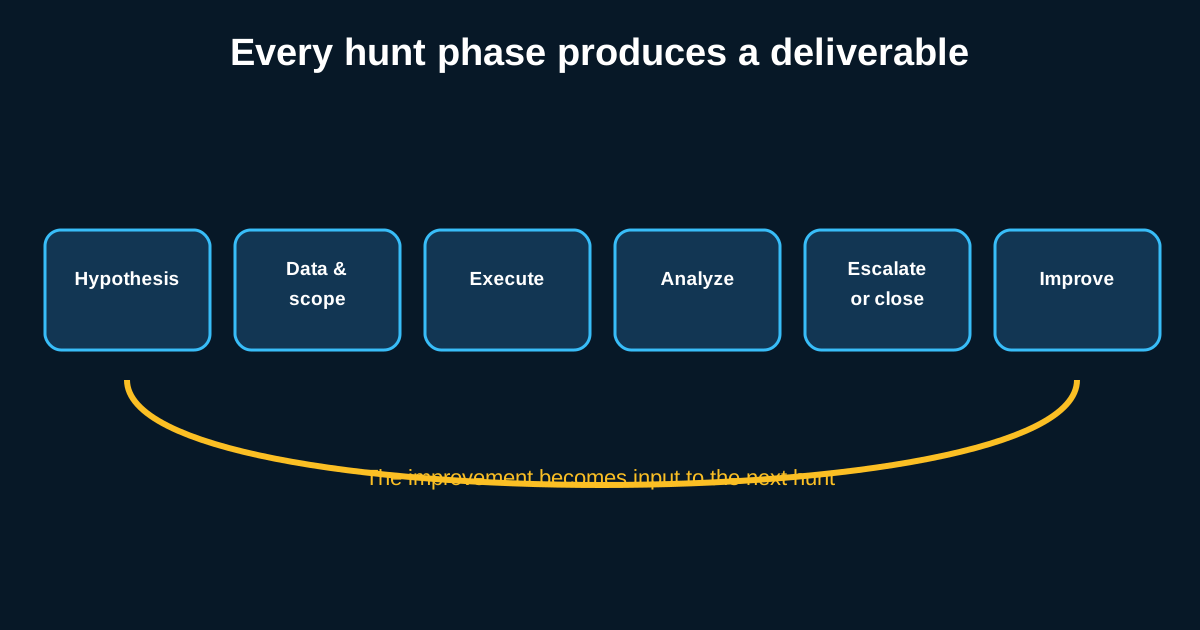
Ask five hunters to describe their process and you’ll usually get five different-sounding answers that, once you strip away the vocabulary, describe roughly the same five or six phases. That’s reassuring, honestly—it means the underlying methodology is stable even when the terminology isn’t. Worth pinning down explicitly, because a hunt missing one of these phases tends to fail in a specific, predictable way.
Phase One: Hypothesis Generation—The Phase That Determines Everything Else
Every hunt starts with a hypothesis, and the quality of that hypothesis constrains everything downstream more than any other single factor. A vague hypothesis like “check for lateral movement” produces a sprawling, directionless hunt with no clear finish line. A sharp one—”if an attacker used pass-the-hash against our environment, we’d expect to see authentication events with a specific logon type from accounts that don’t normally use interactive logons”—gives you something testable, with a clear stopping point whether the answer is yes or no.
The deliverable from this phase isn’t a feeling that something’s worth checking. It’s a written hypothesis specific enough that two different hunters reading it would design roughly the same query.
Phase Two: Data and Scope Validation—Check Before You Query
Before writing a single query, confirm the data your hypothesis depends on is actually collected, at sufficient retention, in the systems you’re planning to check. This phase gets skipped constantly by less experienced hunters, and it’s the single biggest source of wasted effort—running a beautifully constructed query against a data source that was never actually being logged in the first place, and mistaking the empty result for a clean bill of health.
The deliverable here is a short scoping note: which hosts, which log sources, which time window, and—critically—an honest note on any gaps that might limit what the hunt can actually prove. Say your hypothesis needs 90 days of PowerShell logging but your retention is only 30—that’s worth documenting up front, not discovering three hours into the hunt.
Phase Three: Execution—Where Most of the Actual Time Goes
This is the querying, filtering, and narrowing phase—running the initial broad query, applying filters to reduce a large dataset down to a manageable set of candidates, and investigating those candidates individually. In the walk-through example from an earlier piece, this looked like pulling 340 scheduled task events and narrowing to six worth manual review. That ratio is fairly typical—most execution work is about narrowing volume intelligently, not investigating everything that comes back from an initial query.
The deliverable is a working log of what was run, what came back, and the reasoning behind each narrowing decision—the hunt log discussed in the documentation piece, kept live during execution rather than reconstructed from memory afterward.
Phase Four: Analysis and Investigation—Separating Signal From Noise
Once you’ve got a manageable set of candidates, this phase is about determining, for each one, whether it’s genuinely anomalous or has a legitimate explanation you haven’t considered yet. This is where the mindset piece on thinking like an attacker pays off directly—the discipline of trying to explain away your own finding before trusting it, rather than escalating the first thing that looks unusual.
The deliverable is a clear verdict on each candidate: confirmed malicious, confirmed benign with documented reasoning, or genuinely inconclusive (which happens, and is a legitimate outcome worth recording honestly rather than forcing a verdict either way).
Phase Five: Response and Escalation—Knowing When You’ve Stopped Hunting
If analysis confirms malicious activity, this phase is the handoff into incident response—and, as covered in the piece distinguishing these disciplines, this is genuinely a different job with a different pace. The hunter’s role at this point shifts from investigation to providing context: what was found, what data supports it, what else should IR check based on what the hunt already uncovered.
The deliverable is a clean handoff package—not IR redoing the hunter’s work from scratch, but building directly on it.
Phase Six: Improvement—The Phase That Makes the Next Hunt Better
The final phase, and the one most consistently skipped under time pressure: converting what was learned into something durable. Did this hunt reveal a detection gap worth closing with a new SIEM rule? Did it reveal a data collection gap worth fixing before the next hunt needs that same telemetry? Did a false positive investigated this time deserve documentation so nobody investigates it again next quarter?
The deliverable is concrete and often small—one new detection rule ticket, one logging configuration change request, one entry in a shared “known benign patterns” reference. Skipping this phase is how programs end up re-learning the same lessons every few months instead of actually maturing.
Why the Order Matters More Than the Labels
Whatever you call these phases, the sequence matters—hypothesis before data validation, data validation before execution, execution before analysis, analysis before response, and improvement always last, feeding back into the next hypothesis generation cycle. Skip a phase and the hunt doesn’t just get sloppier, it tends to fail in a specific, recognizable way tied to exactly the phase that got skipped.
Lifecycle quality check
Before closing, confirm that the hunt has a testable hypothesis, documented scope, verified data coverage, preserved queries, explained candidates, a defensible conclusion, owned follow-up actions, and a recorded improvement. If malicious activity is suspected, record when and why ownership transferred to incident response.
The lifecycle prevents curiosity from becoming an unbounded investigation. Each phase creates a decision or artifact that makes the next phase possible and the final conclusion reproducible.