Mining Your Own Environment for Hunt Hypotheses
How to generate high-value threat hunting hypotheses using deep knowledge of your own environment, without relying on external intelligence.
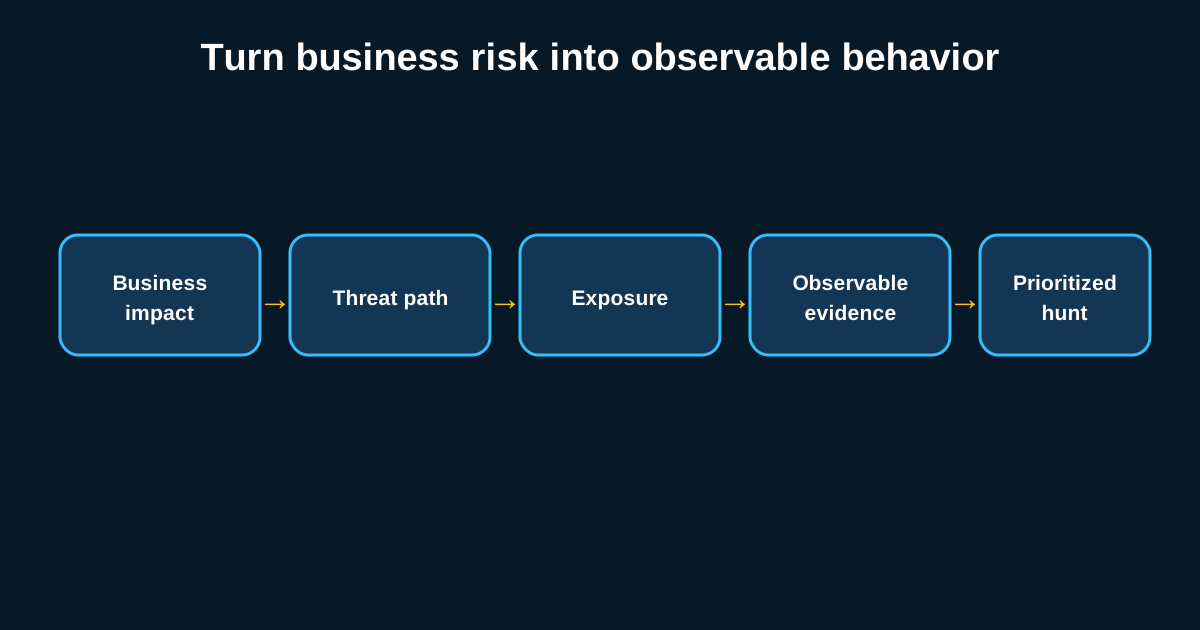
Nobody outside your organization knows that your finance team’s file server has flat access to the entire domain because a migration project from three years ago never got cleaned up properly. No threat intel report is ever going to hand you that hypothesis. It has to come from somewhere else entirely—from actually knowing your own environment better than any generic intelligence source ever could.
Why This Source Gets Underused
External intelligence gets attention because it’s concrete, published, and easy to point to as a source. Environmental knowledge is messier—it lives in the heads of sysadmins, in old architecture diagrams nobody’s updated, in the institutional memory of “oh yeah, that server’s been weird since the migration.” Hunters new to an environment lean on external intelligence by default, simply because it’s more accessible than the tribal knowledge that takes months to accumulate. That’s a real limitation, and it’s exactly why environmental hunting tends to get better the longer a hunter’s been embedded in a specific organization, independent of general skill level.
Start With the Exceptions, Not the Rules
Every environment has documented security policy, and every environment has exceptions to that policy that exist for legitimate operational reasons—a legacy application that can’t support modern authentication, a vendor connection that requires a firewall exception, an old service account with excessive permissions that everyone agrees is a problem but nobody’s prioritized fixing. These exceptions are exactly where hunting hypotheses should concentrate, because they represent the gap between what your controls assume is true and what’s actually true on the ground.
Say your organization has a documented policy requiring MFA on all remote access, but a known exception exists for a legacy VPN concentrator serving a specific manufacturing subsidiary that can’t support modern MFA yet. That’s not a secret—it’s a known, accepted risk. But it’s also precisely the kind of gap an attacker doing even minimal reconnaissance would eventually find, and it deserves a standing hunt hypothesis: authentication anomalies specifically against that concentrator, checked more frequently than your baseline hunting cadence would otherwise dictate, given that it’s a known weak point.
Asset Criticality Should Shape Where You Look First
Not all systems deserve equal hunting attention, and knowing which systems actually matter most to your organization—not generically, but specifically—is knowledge no external source can give you. A hunter who knows that a particular file share holds unreleased product designs, or that a specific database contains the customer records that would trigger the worst possible breach notification obligations, can weight hunting effort toward those assets specifically, rather than spreading attention evenly across systems of wildly different actual importance.
This sounds obvious stated plainly, but it’s surprisingly rare in practice—a lot of hunting backlogs are built purely from external intelligence relevance without ever cross-referencing against “and which of our own assets would this matter most for if it happened here.” Building that cross-reference explicitly—a short list of your organization’s actual crown-jewel assets, updated periodically—gives every other hypothesis-generation method sharper prioritization once it’s in place.
Change Events Are a Quiet, Reliable Hypothesis Source
Recent changes to your environment—a new acquisition being integrated, a cloud migration in progress, a new vendor integration, a reorg that shifted who has access to what—are consistently underused as hunting triggers, and they shouldn’t be. Periods of active change are exactly when misconfigurations get introduced, when access reviews lag behind reality, and when an environment’s actual state diverges furthest from what documentation claims. A hypothesis tied to a recent change is almost always more relevant right now than a hypothesis tied to a six-month-old external report.
Say your organization just completed an acquisition, and the acquired company’s infrastructure was integrated into your network faster than a full security review could keep pace with. That’s not a hypothetical worth waiting on external intelligence to validate—it’s an immediate, high-value hunting priority: check authentication patterns between the newly integrated environment and your core infrastructure for anything that looks like overly broad access that hasn’t been scoped down yet.
Talking to People Who Aren’t on the Security Team
Some of the best environmental hypotheses come from conversations with IT operations, help desk staff, or business unit leads who notice things security never sees directly—a recurring complaint about a specific application behaving oddly, an offhand comment about a shared service account everyone uses because setting up individual accounts was “too much hassle.” These conversations rarely happen systematically, and that’s a missed opportunity. A quarterly check-in with IT operations specifically asking “what’s been weird or annoying lately, security-relevant or not” surfaces hypothesis material that no intelligence feed ever will.
Building This Knowledge Deliberately, Not by Accident
The uncomfortable truth is that environmental knowledge mostly accumulates by accident over time, through tenure rather than deliberate effort. It doesn’t have to. Actively documenting known exceptions, crown-jewel assets, recent changes, and informal tips from adjacent teams—treating this as a maintained knowledge base rather than something that lives only in senior staff’s memory—turns tribal knowledge into a repeatable hunting asset that survives staff turnover.
Run a local discovery session
Meet one system owner and ask what changed recently, which exceptions worry them, which accounts have unusual access, and what “normal” administration looks like. Verify the answers in telemetry where possible. Convert one mismatch between documented design and operational reality into a bounded hypothesis with an owner and review date.
Your environment is a primary intelligence source. Exceptions, critical assets, changes, and operator knowledge often produce more relevant hunts than another generic indicator feed.