Threat Hunting vs. Detection Engineering vs. Incident Response
Understand where hunting, detection engineering, and incident response differ—and how findings move between them.
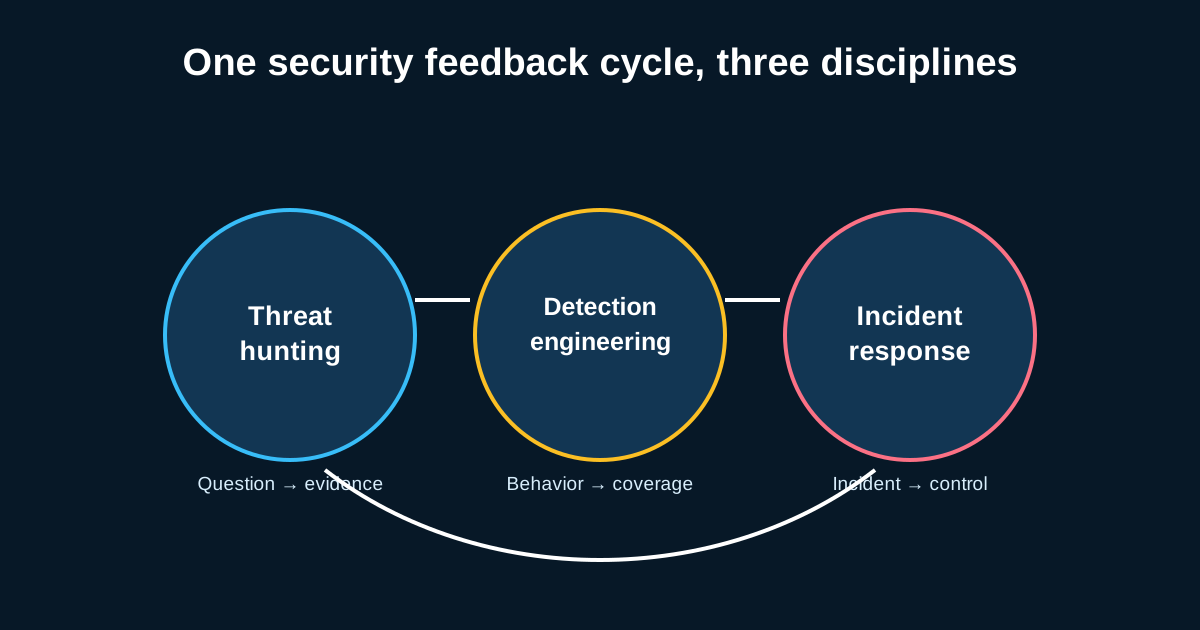
Threat hunting, detection engineering, and incident response often involve the same people, logs, and tools. That overlap makes the work look interchangeable. It is not.
The simplest distinction is the starting point:
- Hunting starts with a question.
- Detection engineering starts with behavior worth detecting repeatedly.
- Incident response starts with a suspected or confirmed incident.
Knowing which mode you are in changes the urgency, the expected output, and the people who need to participate.
At a glance
| Discipline | Trigger | Primary goal | Common output |
|---|---|---|---|
| Threat hunting | Hypothesis, risk, or intelligence lead | Find activity missed by current detections | Findings, visibility gaps, new analytics |
| Detection engineering | A behavior that should be recognized at scale | Create reliable, maintainable detection logic | Tested rule, documentation, tuning data |
| Incident response | Suspected or confirmed compromise | Limit harm and restore safe operations | Containment, timeline, eradication, lessons learned |
Threat hunting: investigate without an alert
A hunt asks whether a plausible malicious behavior is present even though no alert reported it. Hunters define a scope, identify evidence, query, pivot, and test benign explanations.
Example hypothesis:
A compromised service account may be using WMI to reach workstations outside its normal server group.
The output might be a benign explanation, a logging gap, an active incident, or repeatable logic suitable for a detection.
Detection engineering: make repeatable behavior visible
Detection engineers turn security knowledge into analytics that can run consistently. The work resembles software engineering: version control, test cases, peer review, deployment, monitoring, and maintenance all matter.
A useful detection is more than a query that once returned an attack. It should state:
- the behavior and risk it covers;
- required data sources and fields;
- expected false positives;
- test evidence for malicious and benign cases;
- response guidance; and
- an owner and review schedule.
If a hunt discovers that WMI launched a process on an unusual peer workstation, detection engineering might generalize the pattern, add local exclusions, and test it against both simulations and normal administration.
Incident response: control a real event
When evidence indicates compromise, priorities change. Incident response determines scope, contains the threat, preserves evidence, removes attacker access, and restores safe operation.
The handoff from hunt to IR should include:
- the reason for escalation;
- affected identities, hosts, and time range;
- supporting queries and raw evidence;
- confidence and known uncertainties; and
- actions already taken.
Hunters should avoid quietly containing systems unless the response process authorizes it. An uncoordinated action can destroy evidence or warn an attacker.
The work forms a cycle
The strongest security programs make the handoffs routine:
- A hunt reveals a suspicious pattern.
- IR investigates and confirms or rejects compromise.
- Detection engineering captures repeatable behavior.
- Lessons from the incident reveal new gaps and hypotheses.
- Hunters test those gaps, beginning the next cycle.
Without this cycle, teams pay repeatedly for the same lesson.
A practical classification test
Ask these questions during the work:
- What started this activity? An alert suggests triage or IR; a hypothesis suggests hunting; a known behavior needing coverage suggests detection engineering.
- What is the immediate priority? Exploration, durable coverage, and containment require different cadences.
- What is the exit condition? A hunt ends when the hypothesis is sufficiently tested; a detection task ends when the analytic is validated and operational; an incident ends when response criteria are met.
- Who owns the next decision? A hunter can recommend containment, but the incident commander or response process should authorize it.
Mini scenario
A hunter notices a service account launching processes through WMI on three employee laptops.
- Hunting: establish whether the pattern is unusual, expand the scope, and gather evidence.
- Incident response: if compromise is plausible, contain affected assets, protect credentials, and determine impact.
- Detection engineering: after the behavior is understood, create and test logic that identifies recurrence.
The same evidence passes through all three disciplines, but the objective changes at each stage.
Do not define the work by the tool or job title. Define it by its trigger, goal, and exit condition. Clear boundaries make handoffs faster—and tight feedback between the disciplines makes every incident and hunt improve future detection.