Commercial Threat Intelligence Platforms: What Is Worth Paying For?
How to evaluate commercial threat intelligence platforms as a hunter, and what actually separates hunt-useful CTI from an expensive feed.
A vendor demo for a commercial CTI platform will show you a beautiful dashboard, a slick actor-tracking graph, and a search bar that returns results in half a second. None of that tells you whether it’ll make your hunts better. The question that actually matters, and the one demos are built to avoid: when you’re mid-hunt with a specific hypothesis, does this platform get you to a testable hunt faster than free sources would, and is that speed worth what you’re paying for it?
The Real Value Prop Isn’t the Data, It’s the Curation
Most of what commercial platforms aggregate—IOCs, campaign reporting, actor profiles—exists somewhere in open source form too. What you’re actually paying for is curation and correlation: someone’s already done the work of linking a specific IOC to a specific campaign to a specific actor profile, with confidence scoring attached, so you’re not manually cross-referencing five different OSINT sources to establish the same connection.
That’s genuinely valuable when time is the constraint. Consider a hunter gets a vague internal tip about “unusual activity that might be related to a known campaign”—a good commercial platform can take a partial indicator and immediately surface related infrastructure, associated TTPs, and historical campaign context in one search, work that might take an hour stitching together from free sources. Whether that time savings justifies the license cost depends entirely on how often your team is actually running hunts under that kind of time pressure—for a program running one deep hunt a month, the math looks very different than for a SOC handling active incidents weekly.
Actor Attribution: Useful Context, Overrated as a Hunt Driver
Commercial platforms lean hard on actor attribution—this IOC belongs to this named group, tracked with this confidence level. It’s genuinely interesting and has real strategic value. But as covered in earlier pieces on TTPs versus IOCs, attribution matters far less for the actual hunt hypothesis than the underlying technique does. A hunter chasing “is this APT-X” instead of “what would this specific technique look like in our logs” is optimizing for the wrong question.
The practical filter here: when evaluating a platform, check whether its actor profiles link cleanly to reusable technique-level detail—MITRE ATT&CK technique mappings, described procedures—rather than just a confidence-scored name tag and a list of historical victim sectors. A platform strong on attribution but thin on translatable technique detail looks impressive in a sales demo and contributes less to actual hunting than the marketing suggests.
API Access Matters More Than the Web UI
A platform’s web interface is what gets demoed, but for a hunting program with any real scale, API access is what actually determines usefulness. Can you pull enriched IOC data programmatically into your SIEM or hunting platform, or does every lookup require someone manually pasting values into a browser tab? Say a team is hunting across 15,000 endpoints and wants to check a batch of file hashes against the platform’s reputation data—doing that through a web UI one hash at a time isn’t a hunting workflow, it’s a chore.
Check specifically what the API rate limits look like and whether bulk lookups are supported at a price point that matches your actual query volume, not just the headline subscription tier. This detail gets glossed over in sales conversations far more often than it should, and it’s frequently the difference between a platform that integrates into daily hunting work and one that ends up being checked occasionally, out of guilt, because someone’s paying for it.
The Overlap Problem Nobody Budgets For
Organizations running multiple commercial platforms often discover significant overlap in coverage between them, paying twice for substantially similar IOC feeds with different branding on top. Before renewing or adding a platform, it’s worth an honest audit: over the last quarter, how many hunts actually used data unique to Platform A that wasn’t available through Platform B or free OSINT sources you’re already using. If the honest answer is “not many,” that’s a real signal, even if the sales relationship is comfortable and the dashboards look sharp.
Evaluating on Hunt Outcomes, Not Feature Checklists
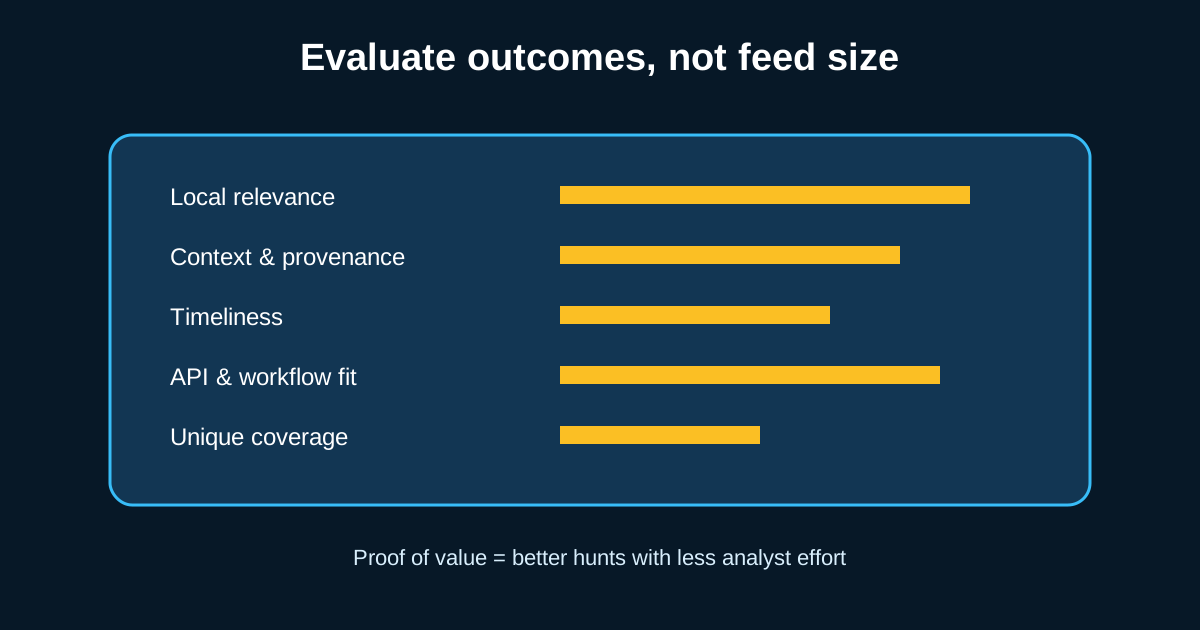
The evaluation approach that actually works: pick three or four real hunts from your recent history—including ones sourced from free OSINT—and re-run the intelligence-gathering portion of each through a candidate commercial platform during a trial period. Compare not the feature list, but whether the platform would have gotten you to the same testable hypothesis faster, with better context, or with genuinely new information you wouldn’t have found otherwise. That’s a far more honest signal than any vendor comparison chart, and it takes maybe a week of trial access to run properly.
Run a proof of value
Give shortlisted platforms the same three recent intelligence requirements. Measure how many relevant items they surface, how much context survives export, how quickly an analyst can create a hypothesis, what duplicates your existing sources, and whether the API fits your workflow. Include analyst time and integration cost in the result.
Pay for reduced uncertainty and analyst effort, not the largest indicator count. A platform is valuable when it repeatedly helps your team make and execute better hunting decisions.