Building a Threat Intelligence Function That Actually Feeds Your Hunts
How to design a CTI function that continuously produces testable hunt hypotheses, instead of a report archive nobody reads.
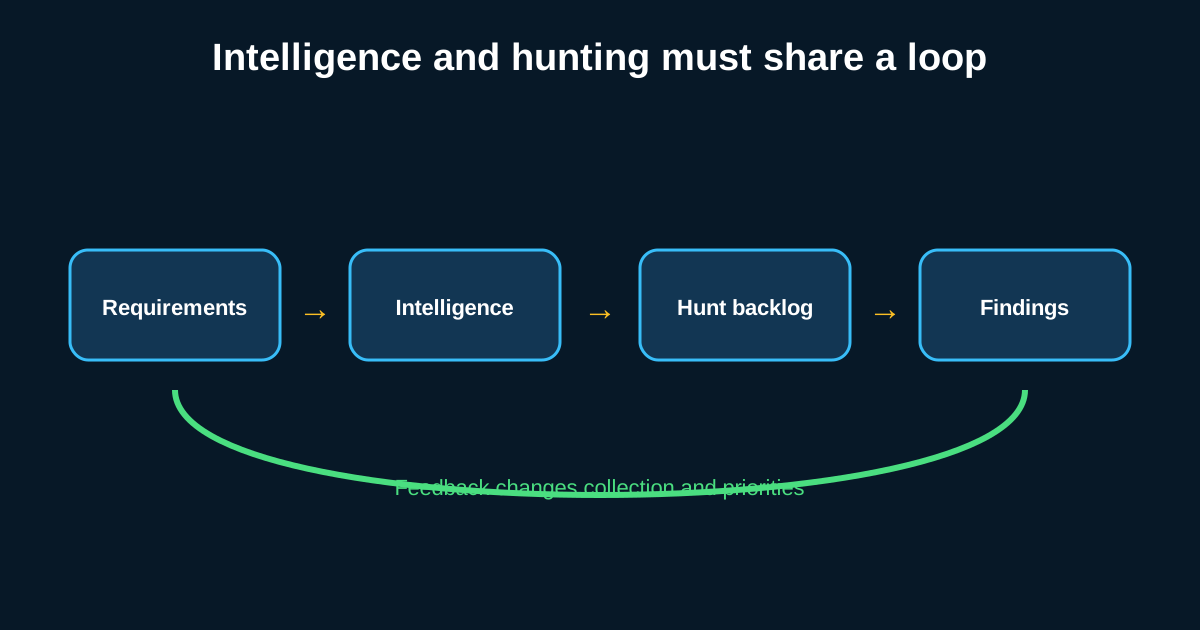
Plenty of security teams have a threat intelligence “function” that amounts to one analyst forwarding vendor emails to a Slack channel that nobody checks. That’s not a CTI program feeding hunting operations—it’s a mailing list with extra steps. Building something that actually drives hunts requires deliberate structure around a genuinely unglamorous question: what happens between “intelligence arrives” and “hunt gets run,” and who owns making that happen.
Start With the Consumer, Not the Collection
The instinct when building a CTI function is to start with sources—which feeds to subscribe to, which platforms to buy. Start instead with who’s consuming the output and what decision it needs to inform. If the primary consumer is your hunting team, the program needs to be built around producing testable hypotheses on a predictable cadence, not comprehensive intelligence reports that read well but don’t obviously convert into a query anyone runs.
This sounds obvious stated plainly, but it’s the single most common structural mistake—building a CTI function modeled on strategic reporting (good for leadership, informs budget and risk conversations) and expecting it to also drive tactical hunting work without any translation layer in between. Those are different outputs requiring different processes, and trying to serve both audiences with one undifferentiated report format usually serves neither well.
The Translation Role Needs an Actual Owner
Every earlier piece on CTI has hammered the same point: intelligence doesn’t become a hunt automatically, someone has to do the translation work from report or feed to testable hypothesis. In a program of any size, that translation needs an explicit owner, even if it’s a shared responsibility rotated weekly rather than a dedicated headcount. Without a named owner, translation becomes everyone’s implicit job and therefore nobody’s actual job—intelligence gets read, maybe discussed briefly, and quietly dies without ever becoming a hunt.
A workable structure for a small team: designate one person per week (rotating) responsible for reviewing that week’s intelligence intake—vendor blogs, community sources, any commercial platform alerts—and producing exactly one to three testable hypotheses to feed into the hunting backlog. Say this rotation produces two solid hypotheses a week across a four-person team—that’s roughly a hundred hunt-ready hypotheses a year, which is far more than most programs actually run through, meaning the bottleneck usually isn’t hypothesis generation once this structure exists, it’s hunting capacity to work through the backlog.
A Hunt Backlog, Not a Report Archive
The output of this translation process needs to live somewhere that’s actually a working backlog, not a folder of PDFs sorted by date. A simple structure—hypothesis, source intelligence it came from, priority, status (untested, in progress, tested-confirmed, tested-not-confirmed)—turns scattered intelligence consumption into a visible, prioritizable queue of actual hunting work. This is also where the earlier documentation habits pay off directly: a well-documented past hunt in this backlog prevents someone from generating the same hypothesis twice from two different intelligence sources without realizing it’s already been tested.
Feeding Hunt Outcomes Back Into Intelligence Priorities
The loop needs to run both directions. Hunts that confirm something significant should inform what intelligence gets prioritized going forward—if a hunt confirms your organization was genuinely targeted by a specific technique, that’s a signal to weight future intelligence collection toward that actor or technique cluster more heavily. Programs that treat CTI as a one-way input into hunting, without ever feeding hunt findings back into what intelligence gets prioritized, lose a genuinely valuable feedback signal that’s sitting right there in their own hunt history.
Sizing the Function to Actual Hunting Capacity
A CTI function that generates far more hypotheses than the hunting team can ever test is its own kind of failure—a backlog of two hundred untested hypotheses isn’t a resource, it’s a graveyard, and it demoralizes the team producing them when nothing ever gets acted on. Size the intelligence intake and translation effort to roughly match actual hunting throughput. If your team can realistically run eight hunts a quarter, a CTI process generating fifty hypotheses a quarter isn’t ambitious, it’s miscalibrated—better to narrow intake sources and go deeper on fewer, more relevant ones than to drown the hunting backlog in options nobody has time to test.
What Good Actually Looks Like Here
A functioning CTI-to-hunting pipeline is boring in the best way—a predictable weekly or biweekly rhythm, a visible backlog with clear ownership, and a rough one-to-one relationship between hypotheses generated and hypotheses eventually tested, rather than an ever-growing pile. Getting the structure right matters more than the sophistication of any individual source feeding into it.
Define the operating contract
For each intelligence product, record the consumer, decision, required delivery time, confidence standard, and expected action. Every hunt candidate should have a hypothesis, local relevance, required data, priority, expiry date, and owner. Review which products generated decisions or hunts each quarter; retire the ones that only generated reading.
An intelligence function succeeds when its outputs change priorities and produce testable work. Collection is an input; better decisions and better hunts are the outcome.