OSINT for Threat Hunters: Free Intelligence, Used Well
A practical guide to evaluating open-source threat intelligence and turning it into testable hunting hypotheses.
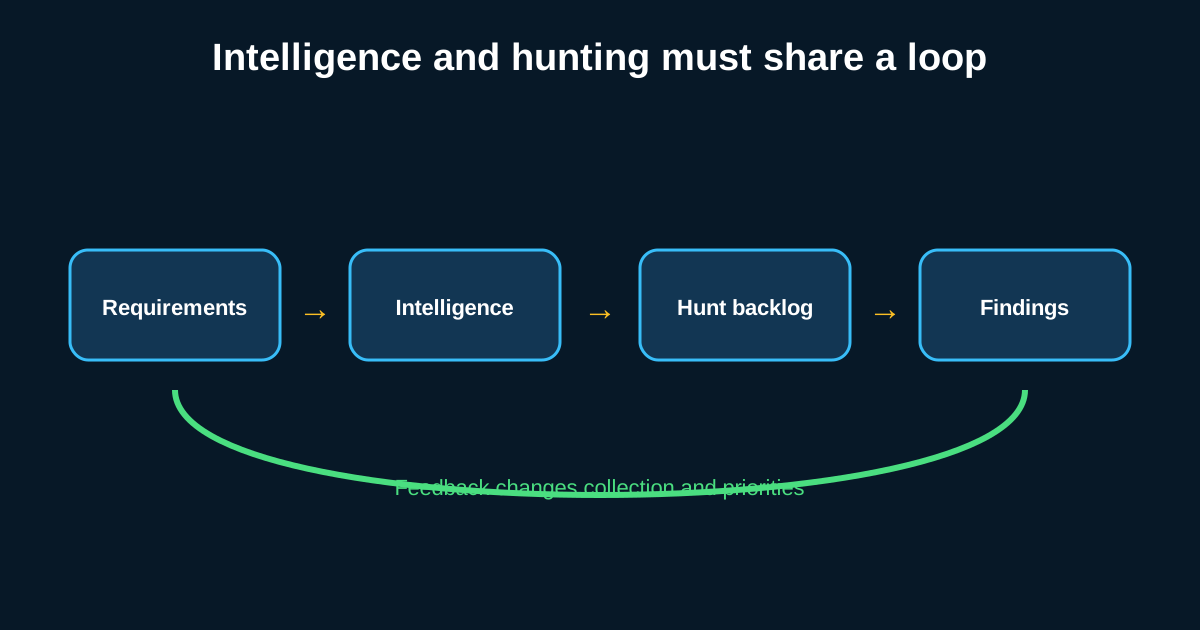
A hunter with zero budget for paid threat intel feeds isn’t actually starting from nothing. Open source intelligence—genuinely free, publicly available sources—covers a surprising amount of ground, if you know which sources are worth your time and, just as important, how to fold them into an actual hunt rather than just reading them passively.
MITRE ATT&CK: The Backbone, Not Just a Reference Chart
ATT&CK gets treated as a static reference most of the time—a chart people glance at, maybe map a detection to once. Used properly, it’s closer to a structured hypothesis generator. Each technique entry includes documented procedure examples from real campaigns, detection guidance, and—this part gets skipped constantly—data source recommendations telling you specifically what telemetry would reveal that technique in your own environment.
The practical habit: when you’re short on hunt ideas, pick a tactic you haven’t hunted against recently, pull three or four techniques under it you haven’t specifically tested, and check the data sources ATT&CK recommends against what you actually collect. Say you haven’t hunted defense evasion techniques in a while—pulling up techniques under that tactic and checking which ones your Sysmon config actually supports gives you a ready-made, prioritized hunt backlog without needing any external report at all.
Vendor Threat Research Blogs: Free, High-Quality, Underused
Major security vendors publish detailed campaign research constantly, often free and genuinely rigorous—this is where a lot of the operational-level intelligence discussed earlier actually originates. The trick is building a habit of reading these with the translation mindset from the previous piece, pulling durable TTPs rather than treating each post as a one-time news item to skim and forget.
A workable routine: pick three or four vendor research blogs known for depth rather than marketing fluff, check them on a set cadence—say, once a week—and for each substantive post, extract exactly one testable hypothesis before moving on. This turns a passive reading habit into a steady trickle of hunt ideas, without needing a paid intelligence subscription at all.
Community Sigma Rules and Detection Repositories
Public Sigma rule repositories aren’t just useful for detection engineering—they’re a legitimate OSINT source for hunters too, because a well-written community Sigma rule usually encodes someone else’s already-validated understanding of a technique’s telemetry signature. Reading through rules relevant to a tactic you’re hunting, even ones you’re not going to deploy as-is, often surfaces detection logic and field combinations you wouldn’t have thought of independently.
Say you’re building a hunt hypothesis around credential dumping and you pull up several published Sigma rules targeting LSASS access patterns. Even if none of them fit your exact log format without modification, the combination of process name, access rights requested, and target process they’re checking for gives you a head start on what your own query should actually look for.
Public IOC and Malware Repositories: Useful, With the Same Caveat
Free repositories aggregating IOCs and malware samples tied to tracked campaigns are worth checking, with the same limitation tactical intelligence always carries—they’re most useful as a routine, low-effort baseline check rather than the centerpiece of a hunting hypothesis. Where these repositories genuinely add hunting value is in the malware analysis writeups often attached to samples, which frequently describe behavioral patterns—process injection techniques, specific registry modifications, persistence mechanisms—that translate into durable hunt logic in the same way vendor research does.
Social Platforms and Security Research Communities
Security researchers sharing analysis, IOCs, and early campaign observations on public platforms move faster than formal published reports, sometimes by weeks. The tradeoff is signal quality varies enormously—some of it’s rigorous, some of it’s speculation dressed up as findings. Treat anything sourced this way as a lead worth verifying, not a confirmed hypothesis worth acting on directly. A useful discipline: if something from an informal source looks worth hunting for, spend ten minutes checking whether it’s been corroborated elsewhere before building a full hunt around it.
Building an OSINT Routine That Actually Feeds Hunts
The failure mode with free intelligence isn’t lack of access—it’s treating consumption as the finish line instead of the starting point. Reading is not hunting. The value only shows up once a source gets translated into a specific, testable hypothesis and actually run against your own data. Building a lightweight weekly routine—a fixed set of sources, a fixed time slot, one hypothesis extracted per session—turns scattered free intelligence into a genuinely steady hunting pipeline, no budget required.
A 30-minute weekly routine
Spend ten minutes reviewing a small, fixed source list; ten minutes validating one useful item against a second source or primary evidence; and ten minutes writing one local hypothesis with required telemetry and an expiry date. Keep a rejection log too. Recording why an item was irrelevant, stale, or unsupported improves source selection over time.
Free intelligence is not free of verification work. Its value comes from careful sourcing, local relevance, and the discipline to turn reading into a bounded test against your own evidence.