Detection Engineering Fundamentals From Hunt to Detection
Learn how detection engineering turns one-off threat hunting findings into durable, tuned detections your SOC can trust.
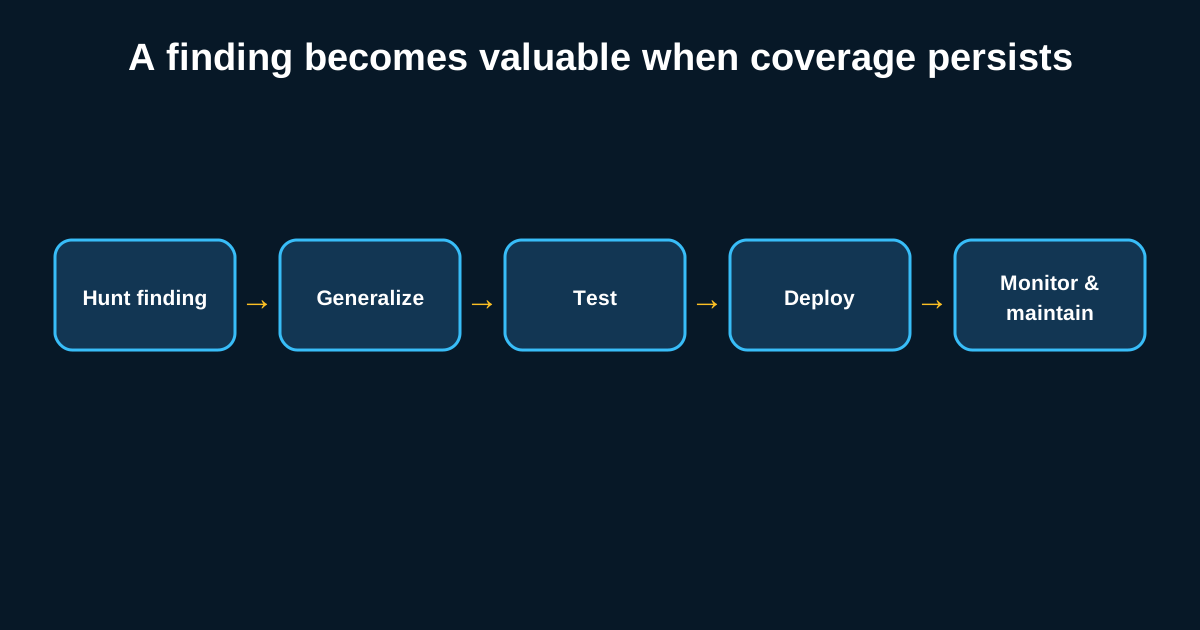
A hunter finds a beacon hiding in DNS TXT records. She writes it up, shares it in the team channel, everyone nods and three months later a near-identical beacon slips through untouched. Nothing was built. Nothing was tested. The finding lived in a Slack thread and died there.
That gap between “we found something interesting” and “we now detect this reliably” is where detection engineering lives. It’s not a fancier name for writing Sigma rules. It’s the discipline that decides whether a hunt’s output becomes institutional knowledge or just a good story from Q3.
Hunting Generates Hypotheses, Not Detections
Threat hunting is exploratory by design. You start with a hunch maybe a TTP from a recent CTI report, maybe an anomaly in process lineage data and you go digging without knowing if you’ll find anything. That’s fine. That’s the job. But a hunt’s raw output is messy: a handful of suspicious hosts, some log excerpts, a working theory about behavior.
Detection engineering takes that mess and asks harder questions. What’s the actual behavioral signature here, independent of this specific incident? What’s the false positive rate going to look like across 40,000 endpoints instead of the three you hunted on? Can this be expressed as a query that doesn’t rely on IOCs that’ll be stale by Friday?
I’ve seen teams treat these as the same skill set, and it rarely works well. Hunters who are great at pattern recognition and pivoting through data aren’t always the ones who think in terms of rule maintainability, alert fatigue, and detection coverage matrices. Both skills matter. They’re just different muscles.
The Pipeline Nobody Talks About
Here’s roughly what a mature pipeline looks like, and where most teams actually break down:
Hunt produces a hypothesis or confirmed technique, then an engineer validates the behavioral logic against a broader dataset, then a detection gets drafted usually mapped against a framework like MITRE ATT&CK for context then the rule goes through staging (alert-only, no paging), then it gets tuned against real traffic for a couple weeks, and only then gets promoted to production with an assigned severity and a response runbook attached.
Most orgs skip staging. That’s the single biggest failure point I’ve watched play out repeatedly. A detection engineer writes a rule based on a hunt finding, feels confident because it worked in the lab, and ships it straight to the SOC queue. Two days later it’s generating 200 alerts a day because some internal scanning tool does something structurally similar to the malicious behavior. Now the SOC either mutes it or ignores it and either way, you’ve burned trust in that detection category for months.
Staging isn’t bureaucracy. It’s the only honest way to find out how a detection behaves against your actual environment instead of your assumptions about it.
Analysis Depth Determines Detection Quality
A weak detection engineer looks at a hunt finding and asks “what field can I alert on?” A strong one asks “what’s the smallest set of conditions that captures this behavior without capturing legitimate ones?” That second question requires real analysis pulling apart the technique, understanding what’s structurally necessary versus incidental to the specific sample you caught.
Take a credential dumping hunt that turned up LSASS access via a renamed process. The lazy detection alerts on the renamed binary name. The good one alerts on the access pattern to LSASS memory regardless of process name, because the attacker will rename the binary again next week and your detection needs to survive that.
This is where investigation skills from hunting directly feed engineering quality. If your hunters are shallow stopping at “found it, moved on” your detections inherit that shallowness. If they dig into why the technique works and what variations are possible, the resulting detection logic is naturally more resilient.
Coverage Is a Map, Not a Checkbox
Teams love to say “we have 340 detections mapped to ATT&CK.” Cool. How many of those detections have actually been validated against a live simulation in the last six months? How many were written once and never revisited as the underlying tooling in your environment changed?
Coverage without maintenance is a false sense of security, and it’s arguably worse than having gaps you know about. A documented gap gets prioritized. A silently rotting detection gets trusted right up until it doesn’t fire.
Building the muscle to move from hunt to detection isn’t about tooling you can do this with open source SIEM stacks or six-figure platforms, the workflow discipline matters more than the tech stack. What matters is treating every hunt as an input to a pipeline, not an endpoint in itself.