Threat Hunting Documentation That Actually Gets Used
Documentation standards for threat hunting that turn hunt outputs into something a team can actually act on, six months from now.
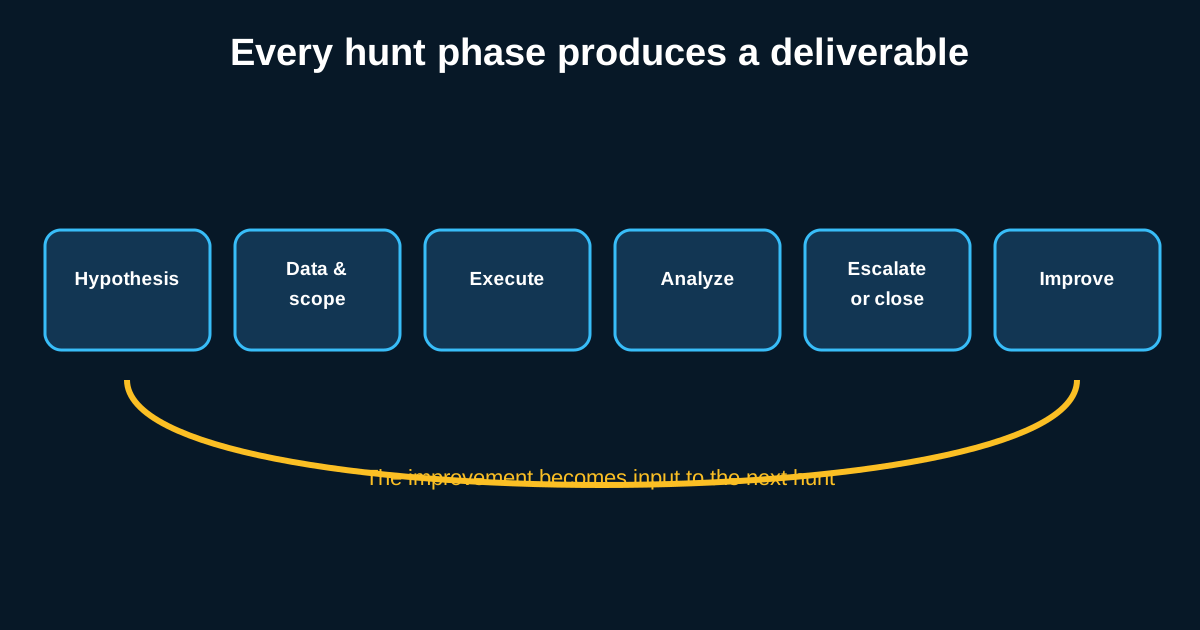
A hunt that isn’t documented well is a hunt that basically didn’t happen, from the organization’s perspective. Six months later, nobody remembers what was checked, what was found, or what the dead ends were—and the next hunter re-investigates the exact same false positive that already got ruled out, because there’s no record it was ever looked at. Documentation isn’t the boring paperwork tacked onto the end of the real work. It’s what makes the real work compound instead of resetting to zero every time.
The Hunt Log: Your Working Memory, Externalized
A hunt log is different from a final report—it’s the running record you keep during the hunt itself, not the polished summary afterward. This should capture the hypothesis as originally written (before you started tweaking it based on early results, which is a natural but important thing to track separately), every query you ran, what each one returned, and your reasoning at each decision point about why you narrowed the investigation the way you did.
The habit that pays off most here is logging dead ends with the same care as live findings. Say you spent forty minutes chasing what looked like anomalous PowerShell execution before confirming it was a scheduled patch management script—write that down with enough detail that a future search for similar activity immediately surfaces “already checked, benign, here’s why” instead of triggering another forty minutes of investigation from scratch.
Structuring the Final Report for the Reader, Not the Writer
A final hunt report needs to serve people who weren’t in your head during the investigation—a SOC manager deciding whether to prioritize a new detection, an IR lead deciding whether something needs escalation, an auditor six months later checking whether a specific technique was ever assessed. Lead with the outcome, not the process. “Confirmed malicious persistence mechanism on HOST-042, escalated to IR” or “Hypothesis not confirmed; scheduled task activity investigated and attributed to legitimate backup software”—that goes first, not buried three paragraphs in after a chronological retelling of every query you ran.
After the outcome, include the hypothesis as tested, the data sources and time range covered, a summary of methodology (enough for someone to reproduce or extend the hunt, not a blow-by-blow), and clear next steps—does this need a new detection rule, does it need IR involvement, does it need to be re-run periodically, or is it genuinely closed.
Standardizing Fields Without Killing Useful Detail
Some structure genuinely helps here—a template with fields for hypothesis, data sources, time range, MITRE ATT&CK mapping (if applicable), outcome, and recommended follow-up makes hunts searchable and comparable across a team. But over-templating kills the value just as fast as under-templating, especially if every field becomes a mandatory dropdown that forces investigators to squeeze nuanced findings into categories that don’t quite fit. Leave room for a free-text findings section where the actual texture of what happened lives, and reserve the structured fields for what genuinely needs to be searchable and consistent—hypothesis, outcome, and ATT&CK mapping usually earn their structure; the narrative of how you got there usually doesn’t.
Findings Databases: Making Past Hunts Actually Searchable
Individual hunt reports, even well-written ones, lose most of their value if they’re scattered across a shared drive with inconsistent naming and no way to search across them. A lightweight findings database—even something as simple as a well-tagged spreadsheet or a Notion database for a small team, something more robust for a bigger one—that lets you search past hunts by technique, by host, by outcome, turns individual reports into institutional memory. Say a new hunter joins and wants to know whether lateral movement via WMI has ever been hunted for in this environment—a searchable findings database answers that in thirty seconds. Scattered PDFs in a folder answer it not at all.
Writing for the Version of You That Forgot Everything
The real test of good hunt documentation: could someone with zero context on this specific hunt—including a future version of yourself, eight months out, who’s genuinely forgotten the details—pick up the report and understand exactly what was checked, what was found, and what to do next, without needing to ask you anything. If the answer is no, the documentation isn’t done yet, regardless of how much time went into the actual investigation.
A minimum useful hunt record
Every completed hunt should preserve: hypothesis, owner, dates, searched time range, assets and data sources, query versions, candidate counts, pivots, evidence, limitations, conclusion, and follow-up owners. Test the document by giving it to a colleague who did not join the hunt. If they cannot reproduce the search or explain the conclusion, revise it.
Documentation is part of the detection system. It stops teams from repeating dead ends and makes good reasoning available long after the original hunter has forgotten the details.