Hunting Initial Access: Catching the Breach Before It Begins
How to hunt for the techniques adversaries use to gain their first foothold, before it turns into a deeper compromise.
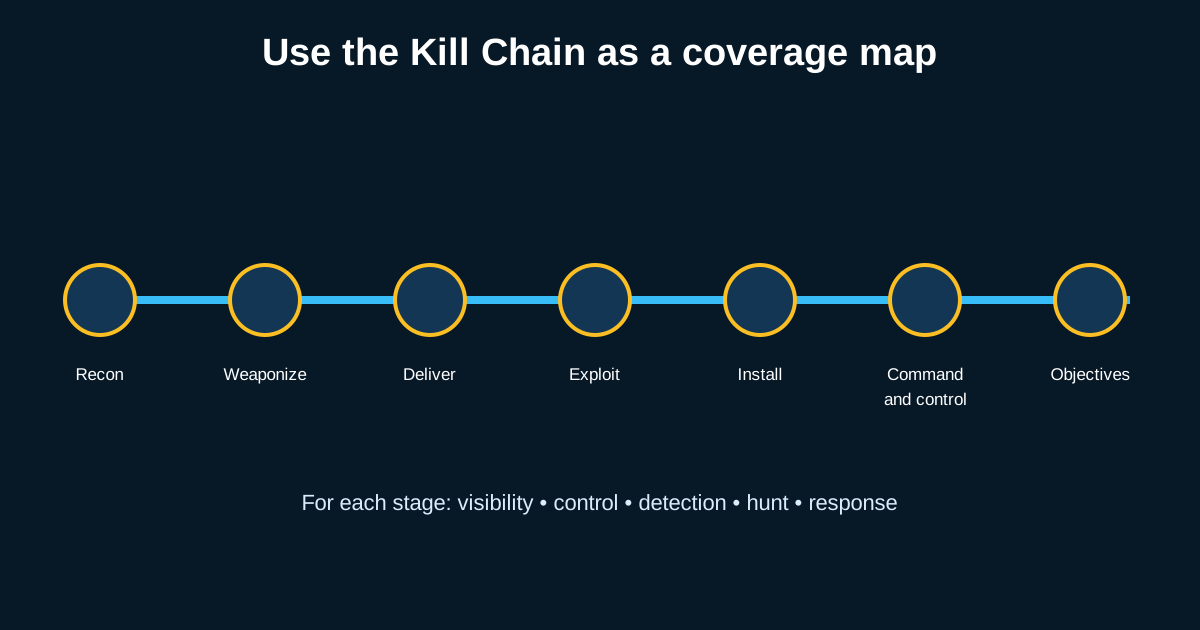
Every intrusion has exactly one moment where it’s smallest and easiest to stop—the first foothold, before lateral movement, before persistence, before anything’s actually spread. Initial access hunting matters more than its position at the start of the kill chain suggests, precisely because the cost of catching something here is so much lower than catching it three stages later, after an attacker’s had time to dig in.
Phishing Still Dominates, and the Evidence Trail Is Richer Than People Assume
Phishing remains the most common initial access vector by a wide margin, and while email security gateways catch a large share of it, hunting still has real value here—specifically for the cases that get delivered but don’t get clicked immediately, or get clicked but don’t trigger an obvious detection. A hunt hypothesis worth running: pull email logs for messages containing links to domains registered recently (tying back to the resource development hunting piece), cross-reference against which recipients subsequently opened attachments or visited those links, and check whether any follow-on process execution or network activity from those users’ hosts looks unusual in the following 24 to 48 hours.
Say this hunt surfaces twelve recipients who received a suspicious email, and cross-referencing endpoint logs shows one of those twelve had an unusual PowerShell execution event twenty minutes after opening the attachment—that’s a much sharper, more specific lead than a generic phishing awareness statistic would ever give you, because it’s grounded in exactly what happened in your own environment this week.
Exploiting Public-Facing Applications: Know Your Own Attack Surface First
Initial access via exploited public-facing applications—a vulnerable VPN appliance, an unpatched web application, an exposed management interface—requires a hunter to actually know what’s externally exposed before hunting for exploitation attempts against it. This connects directly back to the environmental hypothesis generation covered earlier: you can’t hunt effectively for exploitation of a specific exposed service if you don’t have an accurate, current inventory of what’s actually facing the internet.
A practical hunt hypothesis here: for each known externally-facing application, review access logs for request patterns inconsistent with normal legitimate use—unusual URL paths, unexpected HTTP methods, request patterns matching known exploit signatures for that specific application’s disclosed vulnerabilities. Say your organization runs a specific VPN appliance with a publicly disclosed vulnerability from several months back—even if you’ve patched it, a hunt checking historical access logs from before the patch was applied for any signs the vulnerability was actually exploited during the exposure window is worth running, since patching closes the door but doesn’t tell you whether someone already walked through it.
Valid Accounts: The Initial Access Vector That Looks Like Nothing at All
Using stolen but valid credentials for initial access is uniquely hard to hunt for because, by definition, the authentication itself looks completely legitimate from a technical standpoint—right username, right password, no exploit involved at all. This is where the authentication anomaly hunting discussed in earlier pieces on identity data becomes central rather than supplementary. Geographic impossibility (a login from a location inconsistent with the user’s normal pattern, especially combined with a login from their normal location within an implausibly short time window) remains one of the more reliable signals here, alongside access to resources the account doesn’t normally touch.
External Remote Services: The Quiet, Persistent Risk
Abuse of external remote services—RDP, VPN, or other remote access mechanisms exposed with weak authentication or excessive access—deserves specific, standing hunting attention precisely because it’s often a known, accepted risk rather than a surprise, similar to the legacy VPN example from the environmental hypothesis piece. A hunt hypothesis worth running periodically: review authentication logs for remote access services specifically for accounts with excessive access scope, or accounts that haven’t had MFA enforcement applied for documented legitimate reasons, checking their authentication patterns with more scrutiny than the general account population gets.
Drive-By Compromise and Watering Hole Attacks: Rarer, But Worth a Standing Check
Less common for most organizations but still worth periodic attention, drive-by compromise involves a user’s browser being exploited simply by visiting a compromised legitimate website. A hunt hypothesis here connects back to the resource development piece on watching for previously benign, low-traffic sites your organization interacts with beginning to behave unusually—serving unexpected content, redirecting through unfamiliar chains—which can indicate the site itself has been compromised and is now serving malicious content to visitors, including your own employees.
Building Initial Access Hunting Into a Standing Cadence
Unlike some of the deeper, more time-intensive TTP-based hunts covered in earlier pieces, several of these initial access hunts—new domain correlation with email activity, external service authentication review—lend themselves well to a more frequent, semi-routine cadence, since the leading indicators here (new domains, unusual geographic logins) are relatively cheap to check regularly rather than requiring the extended, multi-source correlation that later kill chain stages often demand.