Behavior-Based Hunting: Finding Threats Without a Signature
Use behavioral baselines and contextual anomalies to investigate threats that have no known signature or indicator.
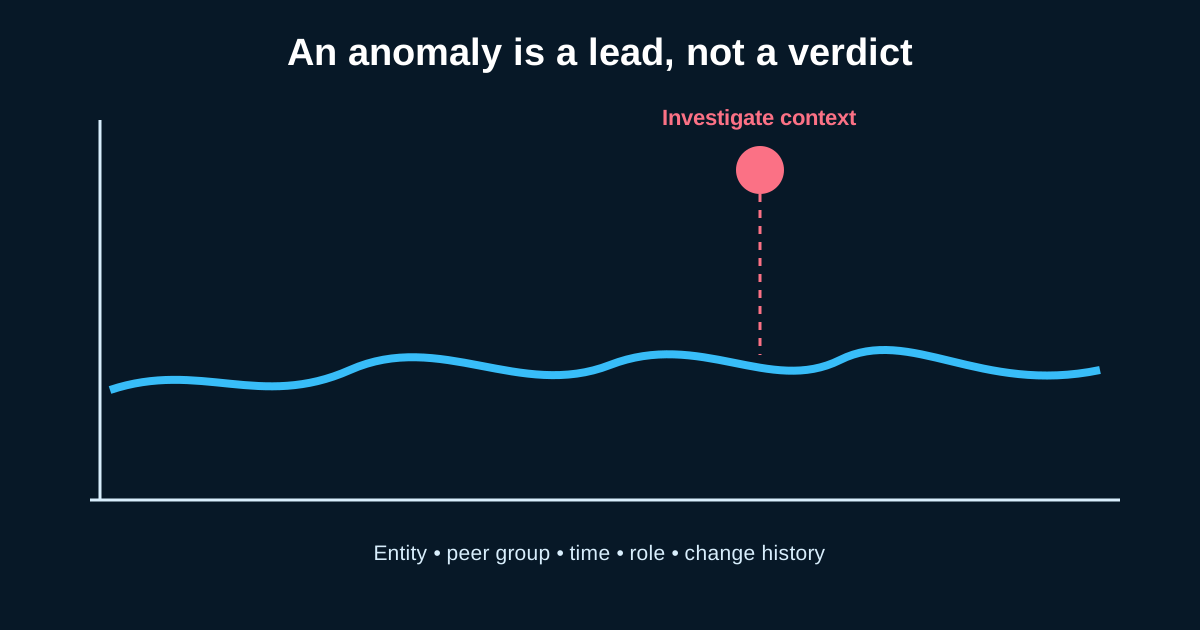
Every signature-based detection, no matter how well written, has one hard limitation baked into its design: it can only catch what’s already been seen and codified. Behavior-based hunting exists specifically to work around that limitation, and it’s the methodology that matters most when you’re worried about something genuinely novel—a technique nobody’s published a report on yet, a custom tool built specifically to evade your particular detection stack.
Starting From “What’s Normal” Instead of “What’s Known Bad”
The conceptual shift behavior-based hunting requires is significant: instead of asking “does this match something known to be malicious,” you’re asking “does this deviate from what’s normal here, in a way that’s hard to explain innocently.” That second question doesn’t require any prior knowledge of the specific threat at all—it only requires a solid understanding of what normal actually looks like in your specific environment, which is a genuinely different kind of preparation than staying current on threat intelligence.
This is exactly why behavior-based hunting is the hardest of the methods covered in this series to do well cold. It requires baseline knowledge that takes real time to build—you can’t behaviorally hunt effectively in an environment you don’t understand yet, no matter how skilled you are generally.
Building Baselines Worth Actually Trusting
A baseline, in practice, is a documented understanding of normal patterns for a specific behavior—normal authentication times and locations for a given account, normal process execution patterns for a given host role, normal data transfer volumes for a given business function. Say you’re building a baseline for a finance department’s typical file server access patterns—a solid baseline notes things like normal access hours (say, 7am to 8pm on weekdays, with occasional legitimate weekend access during month-end close), typical data volumes accessed per session, and the small, known set of accounts that regularly touch this system.
The honest caveat here: baselines take real time to establish credibly, and a baseline built from too short a window will mistake a rare-but-legitimate pattern for an anomaly. A finance system might have genuinely unusual but entirely legitimate activity during annual audit season that a baseline built only from a normal month would flag as suspicious. Building baselines across a full business cycle, where feasible, avoids this specific and common mistake.
Statistical Anomaly Detection as a Starting Filter, Not a Verdict
Once a baseline exists, statistical techniques—flagging activity that falls outside a normal range of volume, timing, or frequency—become a useful first-pass filter for narrowing a large dataset down to a manageable set of candidates worth manual review. This is where behavior-based hunting connects directly to the execution phase discussed in the lifecycle piece: statistical deviation narrows your 40,000 daily authentication events down to the dozen worth actually looking at closely.
The critical discipline here: statistical anomaly is a starting point for investigation, never a verdict on its own. An account authenticating at an unusual hour might be an attacker, or it might be an employee working late on a genuine deadline, or a batch job that got rescheduled. The anomaly earns your attention; it doesn’t earn a conclusion without the same manual investigation and skepticism covered in earlier pieces on the analysis phase.
Behavioral Chains Matter More Than Single Anomalies
A single behavioral anomaly, viewed in isolation, is often explainable innocently and shouldn’t carry much weight on its own. What genuinely matters is whether multiple small anomalies chain together in a way that’s hard to explain as coincidence. Say a single account shows an unusual login time—mildly interesting, probably nothing. That same account also accesses a system it’s never touched before, and also triggers an unusually large file export, all within the same two-hour window. No single element of that chain is damning alone, but the combination, occurring together, is a meaningfully stronger signal than any one piece in isolation.
Building hunt logic around these chains—rather than single-point anomalies—is what separates behavior-based hunting that actually finds novel threats from behavior-based hunting that just generates a constant stream of low-value, individually-explainable false positives.
Accepting a Higher False Positive Tolerance, Deliberately
Behavior-based hunting inherently produces more initial noise than IOC or TTP-based hunting, precisely because it’s not anchored to a known-bad pattern—it’s anchored to statistical deviation, which legitimate rare activity also produces constantly. Accepting and planning for this higher noise floor, rather than treating every false positive as a failure of the method, is part of using this technique honestly. The payoff for tolerating that noise is genuine novel-threat detection capability that signature and TTP-based methods, by definition, can’t offer.
Build a bounded baseline
Choose one entity and behavior, such as service-account destinations by day. Define the peer group, observation window, seasonality, minimum data quality, and known changes. Investigate deviations using identity, process, and network context. Rebuild the baseline when the environment changes materially.
Unusual does not mean malicious. Behavior-based hunting becomes reliable when a transparent baseline and multiple contextual signals turn an anomaly into an explainable sequence.